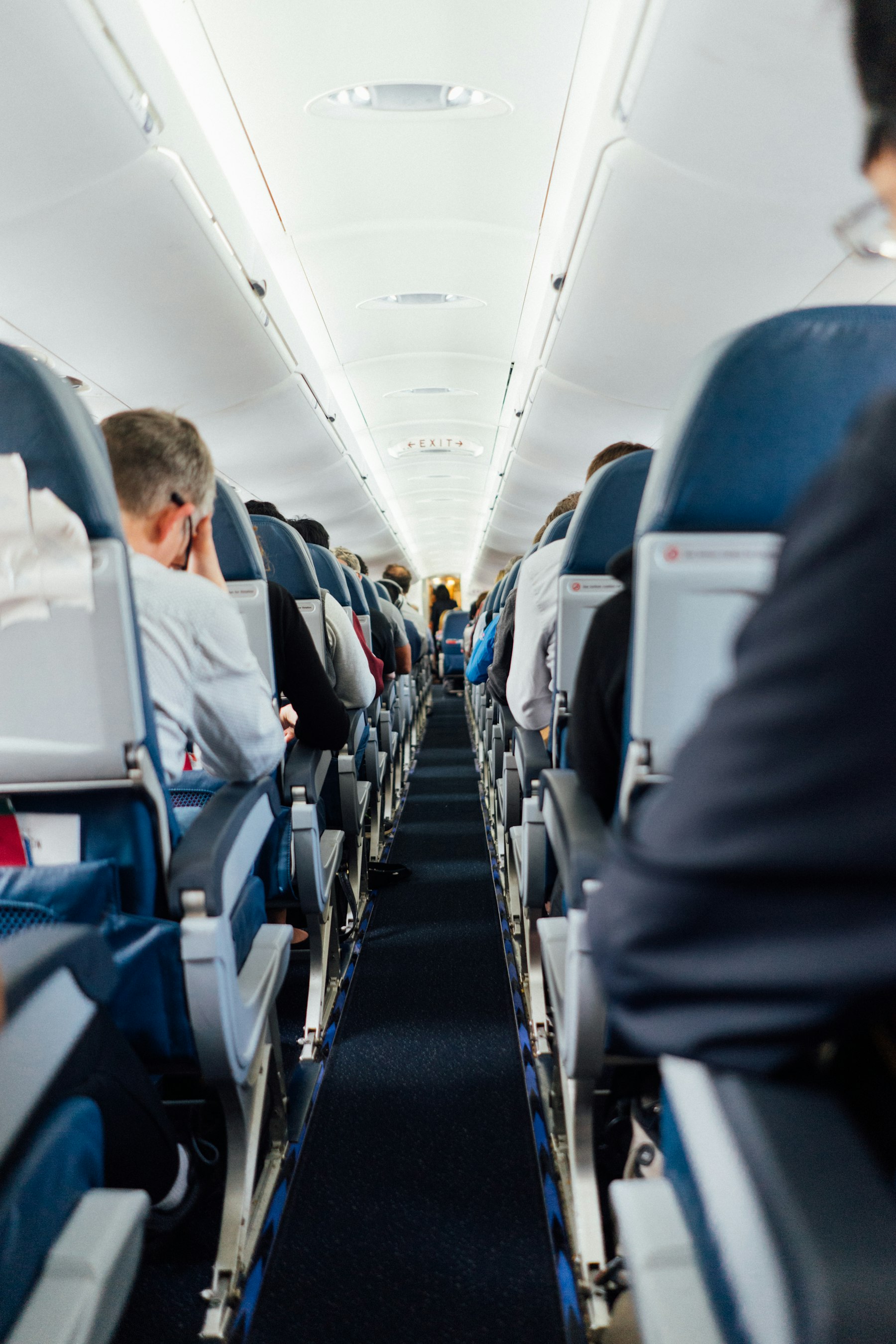
Flying with children is a logistics problem that masquerades as a parenting test. The answers live in seat selection, correct ticket type, a packed carry-on, and a flight time that works with nap math instead of against it.
A lap infant under two flies free domestically but still needs to be added to the reservation. Internationally, expect around 10 percent of the adult fare plus taxes. Do this at booking, not at the airport.
Check · airline policyCheck · international fee
02
Seat selection strategy
Bulkhead for infants on long-haul: more floor space and bassinet eligibility. Mid-rear for toddlers: close to the lavatory, easier to pace the aisle, and less pressure when they are loud.
Check · bulkhead rulesCheck · full row
03
Gate-check plan
Decide before the airport whether you are gate-checking the stroller, checking it at the ticket counter, or traveling without one. Gate-check is free at virtually every airline and gets the stroller to the jet bridge at arrival.
Check · gate tagCheck · destination return
04
Flight timing against nap math
A flight timed to overlap with the child's normal sleep window is not a guarantee of sleep but it is the only rational bet. Red-eyes work better for infants than for toddlers. Early morning departures work better than mid-afternoon.
Check · departure timeCheck · nap overlap
05
Carry-on discipline
Pack everything the child needs for the flight plus a delay plus an accident inside a single dedicated bag kept at your feet. The overhead bin is not accessible with a baby on your lap. Treat it as locked once the door closes.
Check · access bagCheck · snack surplus
§ 02
Where the rule changes by age.
Six cases to compare
Infant under 2, lap ticketFree domestic, ~10% of adult fare international. Add at booking. Bassinet eligible on long-haul bulkhead.
Lap infant / Book early / Bulkhead
Infant under 2, own seatFAA-approved car seat installed on the aircraft. Safest option. Requires a purchased seat and correct installation angle.
Own seat / FAA seat / Safer
Toddler 2-4, first flightsFull fare required. Seat belt fits most airlines starting around age 2-3. Pack heavily. Expect noise.
Long-haul overnightBassinet rows on widebody aircraft for infants. Sleep sacks, white noise, and feeding at descent are the core stack.
Bulkhead / Overnight / Bassinet
Domestic 2-hour hopSame bag discipline applies. Shorter duration means less entertainment required but the same security load.
Short haul / Security first / Light pack
Reserved routes below this guide
Lap Infant RulesDomestic and international lap infant policies, ticketing fees, and what happens at the gate.
L4-01
Best Airlines for FamiliesWhich carriers offer family boarding, seat-together policies, and the best in-flight experience for children.
L4-02
Bulkhead Seats ExplainedThe real pros and cons of bulkhead rows for families: bassinets, tray tables, and the storage tradeoff.
L4-03
Stroller Gate CheckHow to gate-check a stroller, what tags you need, and what happens at connecting airports.
L4-04
Car Seat on the PlaneFAA-approved car seats, installation on aircraft, and when the lap infant option is no longer appropriate.
L4-05
Flying with ToddlersManaging the 18-month to 3-year window: seats, tantrums, snacks, timing, and survival strategies.
L4-06
Overnight Flights with KidsHow to structure overnight routes around sleep: what works, what doesn't, and how to land functional.
L4-07
Airport Security with KidsTSA rules for strollers, car seats, formula, breast milk, and how to move a family through screening fast.
L4-08
Flight Entertainment for KidsWhat actually works on a plane: offline apps, headphone strategy, screen time limits, and backup plans.
L4-09
Family Carry-On PackingThe definitive carry-on list for flying with children: snacks, wipes, change of clothes, entertainment, and medications.
L4-10
§ 03
Trip shape changes the answer.
Under-2 infant, domesticFree lap ticket, gate-check stroller, bulkhead or rear aisle preferred
Free lap / gate-check / bulkhead
Under-2 infant, international long-haul~10% adult fare, bulkhead for bassinet, red-eye if infant sleeps on schedule
10% fare / bassinet row / overnight
Toddler 2-4, any routeFull-price seat required, own entertainment, rear section preferred for aisle access
Full fare / rear section / heavy snack
School-age, long-haulScreen-based entertainment carries the flight; headphones, downloaded content, backup games
Tablet / headphones / offline content
§ 04
The decision brief in order.
Rule 01
Add the infant at booking.
Lap infant tickets on international routes carry fees and availability limits. Adding at the airport introduces risk on sold-out flights.
Rule 02
Pick the seat before picking the airline.
A cheaper fare on an airline with poor seat-together policies creates more stress than it saves in money.
Rule 03
Pack the carry-on for a 6-hour trip even if flying 2.
Delays, diversions, and slow deplanes happen. The parent who packed for the actual flight is not the parent who lands calm.
Rule 04
Arrive at the airport earlier than you think.
Security with a stroller, car seat, diaper bag, and a toddler takes longer than security as an adult. Add 30 minutes minimum.
Rule 05
Download entertainment before you leave the house.
Airport and in-flight Wi-Fi is unreliable. A tablet with offline apps, movies, and games is the only guaranteed entertainment supply.
Rule 06
Feed or nurse during descent.
Swallowing equalizes ear pressure for infants. The feeding window during descent is a medical strategy, not a comfort preference.
§ 05
Reader questions before committing.
Useful edge cases to check.
When should you book lap infant tickets? At the same time as adult tickets. Domestic U.S. infants typically fly free as lap children under age two but still need to be added to the reservation. International lap infants are usually charged around 10 percent of the adult fare plus applicable taxes.
Which seats are best for families on a plane? Bulkhead rows for infants: most floor space and bassinet eligibility. The rear section for toddlers: close to the lavatory and less visible if a tantrum happens. Exit rows are never allowed for families with children under 15.
Can you bring a stroller to the gate? Yes. Most airlines allow one stroller and one car seat to be gate-checked free. The stroller is usually returned at the jet bridge, but ask the gate agent because some routes return it to baggage claim.
What do you pack in a carry-on for a toddler? Snacks for double the flight duration, a change of clothes for the child plus one shirt per adult, wipes, extra diapers or pull-ups, a tablet with downloaded offline content, child headphones, a comfort object, and any medications in original packaging.
This L3 page keeps the deeper links in place so the article network can be filled out without flattening the travel architecture.
Book Desk / Flights / L3 Mini-Hub 002
Flying with Kids — Everything You Need to Book, Pack, and Survive the Flight
How to book flights for families with children: lap infant rules, seat selection strategy, bulkhead rows, airport timing, and what actually keeps kids calm at 35,000 feet.
Seat selection, lap infant ticketing, carry-on discipline
Lap infants: free domestic, ~10% adult fare international
Gate-check: stroller plus car seat, both free at most airlines
Bulkhead: best for infants, bassinet-eligible on widebodies
Arrive 30 minutes earlier than you think with a young child
The memorable thing: flying with kids is a logistics problem, not a parenting test. The families who arrive calm packed correctly, booked the right seats, and planned the security lane before they left the house.
Every piece of family flight stress can be traced to a decision made before the airport. The wrong ticket type for an infant costs money or boarding confusion. The wrong seat costs access to the lavatory and somewhere to pace a restless toddler. The wrong carry-on strategy means the one bag you need is in the overhead bin with a baby on your lap and the doors closed. None of these are emergencies. They are all preventable with about twenty minutes of planning at the time of booking.
This page is the command structure for that planning. It gives the full editorial brief for every decision a parent faces when booking flights with children, then reserves the deeper L4 articles for topics that deserve their own focused treatment: lap infant rules, bulkhead seat tradeoffs, gate-check procedure, car seat FAA compliance, overnight flight strategy, and the full carry-on list. The goal is to give the search result and the reader a real answer at this URL, not a placeholder that promises depth it never delivers.
Flying with Kids / Field Note
Lap infant ticketing — the rules that catch people
A lap infant is a child under 24 months of age who does not occupy a purchased seat. On domestic U.S. flights, most major carriers allow lap infants to fly free, but the infant must be added to the reservation before travel. This is not optional. The infant needs to appear on the flight manifest for headcount and safety compliance. Showing up at the counter without the infant on the reservation creates problems even when the flight is not full.
International flights are different. Most carriers charge a lap infant fare of approximately 10 percent of the adult base fare, plus applicable taxes and airport fees. On some popular international routes this can amount to several hundred dollars per trip even though the child is not in a seat. The fee structure varies by carrier and route, so verify directly with the airline at time of booking. Budget airlines and low-cost international carriers may have different policies than flag carriers. The general rule: check the airline's website for the current lap infant policy on your specific route before assuming the domestic free-child rule applies overseas.
The safest option for infants on any flight is an FAA-approved child restraint device installed in a purchased seat. The American Academy of Pediatrics and the FAA both recommend this for children who have not yet reached the height and weight limits for aircraft restraint systems. Lap infant travel is legal but it is not the recommended safety posture for infants under approximately 20 pounds on turbulent routes. Parents booking long-haul overnight international flights should weigh the cost of a purchased seat against the comfort and safety benefit of the child being secured in a car seat through the night.
Booking the lap infant early matters for seat selection. On widebody international aircraft, bassinets attach to the bulkhead wall and are only available in certain rows. These rows have limited inventory. A parent who books an infant late may find that all bassinet-eligible seats are taken. The bassinet itself must be reserved with the airline and is not guaranteed, but being in a bulkhead row is the prerequisite. Book early, request the bassinet during booking or via customer service, and confirm within 72 hours of departure.
Flying with Kids / Field Note
Seat selection strategy for families
There is no perfect seat for every family. The right choice depends on the child's age, the flight duration, whether a bassinet is needed, and how important lavatory access is. The framework is simple: infants benefit from bulkhead rows; toddlers and older children often do better in the rear section near a galley and lavatory; exit rows are never available to families with children under 15.
Bulkhead seats are the front row of a cabin section, facing a wall or divider rather than another row of seats. The advantages: more floor space (valuable when a toddler needs to stand or play), no reclined seat in front of you, and bassinet eligibility on international widebody aircraft. The disadvantages: tray tables fold out of the armrest rather than the seatback, so they cannot be used while the child is in a lap infant position; there is no under-seat storage because the wall is in front of you; and overhead bin space in the immediate area may be shared by a larger group. On aircraft where the bulkhead row is the first row of economy, it may also be near the galley and lavatory, which some families consider an advantage and others find noisy.
The rear section of the aircraft — roughly the last four to six rows — sits near the lavatories and is often the last area to fill on a less-than-full flight, making it possible that an adjacent seat stays empty. The back is noisier due to engine placement on many aircraft types, but for families with toddlers who need to stand in the aisle or pace, having the lavatory close reduces the disruption to other passengers significantly. Gate agents sometimes offer families with infants an opportunity to move to a partially empty row after boarding; being positioned toward the rear increases the chance of this.
For families of three or four needing to sit together, book the full row as early as possible. Seat-together guarantees vary dramatically by airline. Some carriers like Southwest use open seating and rely on gate priority to keep families together. Others like Delta will hold adjacent seats for families booking at the same time, while budget carriers may charge seat selection fees and offer no formal family seating guarantee. If the airline's website does not show seats together at time of booking, call the airline directly before purchasing because some seat-together protections require manual intervention.
Flying with Kids / Field Note
Stroller and car seat gate-check procedure
Gate-checking is the practice of bringing the stroller or car seat through security and to the aircraft door, where you hand it to the ground crew to be placed in the cargo hold. It is returned at the jet bridge when you deplane, rather than going to baggage claim. This is the most practical arrangement for most families because it eliminates the need to carry an infant through the airport without a stroller and avoids the stroller being lost or damaged in the checked baggage system.
At virtually every major U.S. carrier, one stroller and one car seat may be gate-checked at no charge regardless of your baggage allowance. This policy applies even on basic economy tickets at most airlines. Pick up a gate-check tag from the agent at the departure gate. Fold or collapse the stroller at the jet bridge entrance and hand it to the crew member there. Leave the car seat in its bag if you have one, as car seat travel bags reduce the chance of damage.
The complication arises at connecting airports. On some routes, particularly those with a connection that requires a deplaning and reboarding, the gate-checked stroller may not come back to the jet bridge and may instead be transferred to the next gate or to baggage claim. Ask the gate agent at departure whether the stroller will be returned at the jet bridge at the connection, and confirm again at the connection gate. Do not assume. A family that assumes the stroller will be at the jet bridge and discovers at the bottom of the jet bridge stairs that it is not now has to navigate a connecting airport terminal with an infant and no mobility device.
Umbrella strollers are easier to gate-check than full-size travel systems. Many experienced family travelers use a lightweight umbrella stroller specifically for air travel and leave the full stroller at home or at the destination. The umbrella stroller fits in overhead bins on some regional jets and can be collapsed and stowed faster at the gate. If the child is past infancy and the trip is short, consider whether a carrier or a baby carrier backpack eliminates the stroller entirely as a simpler option.
Flying with Kids / Field Note
Car seats on the aircraft — FAA approval and installation
The FAA approves the use of child restraint systems on aircraft when the seat bears the label reading "This restraint is certified for use in motor vehicles and aircraft." Most standard car seats carry this label. A car seat used on an aircraft must be installed in a forward-facing position in an aircraft seat, secured with the aircraft lap belt, and cannot block the exit path of other passengers. The car seat cannot be placed in an exit row, a row immediately adjacent to an emergency exit, or any row where its installation would obstruct the aisle.
Traveling with a car seat requires a purchased aircraft seat for the child. You cannot use a car seat in a lap infant position. The car seat occupies the aircraft seat, and the child is secured in the car seat using the car seat's harness. This is the safest arrangement for infants and toddlers under approximately 40 pounds, according to both the FAA and the American Academy of Pediatrics, because the aircraft lap belt is designed for adult body mass and does not restrain a small child effectively during turbulence or an emergency deceleration.
Practical notes for parents traveling with a car seat: attach a luggage tag identifying it as yours; carry the car seat in a travel bag if possible; and know that the seat may need to be installed on the window seat in some row configurations due to aisle-obstruction rules. Practice installation before the airport if you have not done it in a confined space before. An aircraft seat is narrower than a car seat and the process of threading the lap belt, securing the seat, and confirming the recline angle can be slower than expected when boarding is in progress.
Flying with Kids / Field Note
Timing flights around nap schedules and sleep windows
The single most impactful booking decision for families with infants and toddlers is flight timing. A flight that overlaps with the child's normal sleep window improves the odds of sleep on the plane, which reduces the duration of active management required from parents and significantly improves the arrival condition of everyone on board.
For domestic flights with infants under 12 months, early morning departures are generally the best option. Most infants sleep after morning feeding and may sleep through a short flight entirely. Early morning departures also minimize airport wait time and exposure to airport crowds. The airport is quietest before 8 a.m. and security lanes typically move faster.
Red-eye flights work well for some infants but poorly for toddlers. Infants who have a predictable bedtime sleep period may sleep through a red-eye; toddlers who are overtired and overstimulated in a strange environment often do not. Parents considering a red-eye with a toddler should weigh the possibility of a non-sleeping toddler on a nighttime flight against the schedule advantage. For most families, a morning departure is more reliable than a red-eye gamble.
On international long-haul routes, overnight flights are often the most sensible option for families with infants, particularly if the destination is on the other side of a time zone shift. The child's circadian rhythm will be disrupted regardless of flight timing; the goal is to minimize the duration of the awake window during the flight itself. An overnight departure that aligns with the child's normal bedtime and lands in the morning gives the family a full arrival day to reset the schedule.
Avoid mid-afternoon departures with young children whenever possible. The late afternoon window is when most infants and toddlers are at their lowest energy regulation point, most likely to be overtired, and most likely to behave unpredictably in an overstimulating airport environment. If the fare difference between a morning and afternoon flight is small, the morning flight is almost always the better family choice.
Flying with Kids / Field Note
Airport security with children — the correct procedure
TSA rules for families with young children are more permissive than standard rules in some areas and identical in others. The critical permissions: liquids for infants and young children, including formula, breast milk, and juice, are exempt from the 3-1-1 rule and may be carried in quantities exceeding 3.4 ounces. They must be declared at the checkpoint and may be screened separately. Ice packs and gel packs used to keep breast milk cold are also allowed in quantities reasonably necessary for travel.
Strollers and car seats must go through the X-ray machine or be inspected manually. Collapse the stroller at the checkpoint belt and place it on the belt or hand it to the TSA officer. Remove the child from the stroller before the stroller goes through. Children under 12 do not need to remove shoes. Children in carriers may be able to stay in the carrier for screening, but this varies by TSA officer and security lane. Ask first.
The practical guidance: arrive at the airport at least 90 minutes before a domestic departure and 2.5 to 3 hours before an international departure when traveling with a young child. Add 30 minutes minimum to whatever timeline you would normally use as an adult. Security with a stroller, a diaper bag, a carry-on, shoes for adults, and a toddler who cannot move quickly requires significantly more time than a solo traveler. Families who rush to security carry that stress onto the plane and it radiates to the child.
TSA PreCheck is worth having for traveling parents. The PreCheck lane does not require liquids removal, laptop removal, or shoe removal, and the lanes tend to be shorter. The expedited screening significantly reduces the cognitive and physical load of moving through security with a child and gear.
Flying with Kids / Field Note
The family carry-on — the complete list
The standard rule for flying with a young child is to carry everything you will need from departure through one emergency delay, packed into a bag that fits under the seat in front of you. The overhead bin is inaccessible once the door closes and you have a child in your lap. Plan accordingly.
The core carry-on list for an infant or toddler: diapers and pull-ups in sufficient quantity for the flight plus a three-hour delay, wipes (two packs minimum), a changing pad, two to three complete change-of-clothes outfits for the child, at least one clean shirt per adult, hand sanitizer, any prescription or OTC medications in original packaging, formula or breast milk for the flight plus a delay, age-appropriate snacks in sufficient quantity for twice the flight duration, a pacifier or comfort object, and a light blanket or swaddle for sleep.
For children old enough for screen-based entertainment (roughly 18 months and up): a tablet loaded with offline content downloaded before leaving the house, child-sized headphones with volume limiting, a charging cable and portable battery, and at least one physical backup toy or activity book for when the screen gets boring or the battery dies. Do not rely on the airline's in-seat entertainment system for a child; it may not exist, may not work, or may not have age-appropriate content for your specific child.
Snack packing is its own skill. The most effective snacks for toddlers in flight are items that require chewing time, are not messy, are familiar and reliable, and come in individually wrapped portions that can be rationed. Pouches, crackers, raisins, cut fruit in a sealed container, and cereal bars are consistently effective. Bring far more than you think you will need. A delayed flight with a toddler and no more snacks is a specific kind of misery that is entirely avoidable with an extra bag of crackers.
Everything in the carry-on should be accessible with one hand. Test this before you leave for the airport. If retrieving an item requires two hands, reorganize until it doesn't. You will spend a significant amount of the flight with a child on one arm and will need to reach into the bag for snacks, wipes, and entertainment items without putting the child down.
Flying with Kids / Field Note
In-flight entertainment for children — what actually works
The entertainment strategy for a child on a plane is not about finding the perfect app or the right movie. It is about pacing the entertainment across the duration of the flight with enough variety to manage the child's attention span in a constrained environment with no escape. The specific content matters less than having multiple types of content available and the discipline to ration them strategically.
For infants under 12 months, in-flight entertainment is largely irrelevant. Feeding, holding, movement, and familiar comfort objects are the tools. A white noise app can help if the plane's cabin noise is not already functioning as white noise, which it often is. The goal for infants is sleep; everything else is noise management and holding.
For toddlers 12 months to 3 years, the entertainment stack needs to be high-variety and low-commitment. No single activity will hold a toddler for more than 10 to 20 minutes. The correct approach is to have a sequence of different activities: a favorite show episode, a simple puzzle or stacking toy, a snack period, a board book, a song, another show, another snack, a walk up the aisle, a new toy that was hidden until the flight specifically to be novel. The novelty of a new inexpensive toy purchased before the trip and revealed mid-flight can provide 30 to 40 minutes of engagement on its own.
For children 3 to 5, tablets become more effective. Apps that are interactive rather than passive — drawing apps, simple games, toddler puzzles — hold attention longer than passive video. Download several different types of content. Children at this age also respond well to being given some control over the sequence; offering a choice between two activities is more effective than presenting one option.
For children 5 and up, screen-based entertainment largely carries the flight. The primary tasks are: ensure the tablet is charged, the content is downloaded offline, the headphones fit and stay on, and there is a backup physical activity for the point when the screen time limit becomes a negotiation. Most families find that noise-canceling or volume-limiting children's headphones significantly improve the quality of screen time in-flight by allowing the child to hear clearly and reducing the cognitive load of noisy cabin environments.
One important note on in-seat entertainment systems: many newer aircraft have screens at every seat, and many airlines have children's programming available. These are useful supplements but not substitutes for a packed tablet. The systems are sometimes broken, sometimes lack the specific content your child wants, sometimes require payment for premium content, and sometimes have headphone jacks that do not fit children's headphones. Bring your own setup as the primary; treat the in-seat system as a bonus.
Flying with Kids / Field Note
The best airlines for families — what to look for
There is no single best airline for families because the answer depends on your route, the child's age, the trip length, and what you are optimizing for. The evaluation criteria that matter most are: formal family boarding policy, seat-together guarantee, lap infant fee structure, gate-check policy, and in-flight entertainment quality.
Southwest Airlines uses open seating, which means no assigned seats. Family boarding is offered after A group and before B group, giving families access to the best remaining open seats at that point. Families with children under 6 board early enough to secure adjacent seats together on most flights. The lack of assigned seats removes the booking-seat-selection anxiety but requires early arrival at the gate to get a good boarding position.
Delta offers a formal family boarding policy and has implemented seat-together protections that are more reliable than most carriers. Delta's in-flight entertainment system is strong, SkyMiles has family pooling, and the carrier's domestic network is extensive. For long-haul international travel, Delta's premium cabin options for families with older children who can manage the longer flight are competitive.
Alaska Airlines boards families with children under 2 years before general boarding and has a consistent reputation for friendly handling of families. The carrier's West Coast network is useful for families traveling to Pacific Northwest, Hawaii, and Alaska destinations.
JetBlue offers family boarding and its Fly-Fi internet service is reliable enough for streaming on shorter domestic routes when offline content is supplemented. The carrier's focus cities are primarily East Coast and select leisure markets.
Internationally, Emirates consistently rates highly for families on long-haul routes due to strong in-flight entertainment, decent bassinet availability on widebody aircraft, and well-trained cabin crew. Singapore Airlines and Air New Zealand also have strong reputations for family-friendly long-haul service. The practical variables on any international route: bassinet availability, meal options for children, and whether the aircraft assigned to your route is a widebody with individual screens or a narrowbody with limited in-flight amenity.
The single most important airline selection criterion for families with children under 3 is the seat-together guarantee. An airline that cannot or will not guarantee adjacent seating for a parent and an infant is not an appropriate choice regardless of fare savings. Verify the policy before purchasing and confirm it again at the time of seat selection.
Flying with Kids / Field Note
Overnight flights with children — the real strategy
Overnight international flights with young children are one of the most discussed and most misunderstood topics in family travel. The honest assessment: overnight flights can work well with infants and work poorly with toddlers, and the outcome is more dependent on the child's individual temperament and sleep habits than on anything a parent can control.
The case for overnight flights with infants: a well-timed overnight departure that aligns with an infant's normal bedtime may result in the child sleeping through most or all of the transatlantic portion of the flight. The bassinet in a bulkhead row makes this most viable, as it removes the need to hold the child continuously for eight or nine hours. The case against: an infant who does not sleep on the flight results in two severely sleep-deprived parents arriving at their destination needing to function from day one.
The case for overnight flights with toddlers is weaker. Toddlers are easily overstimulated by the airport environment, the boarding process, the novelty of the aircraft, and the social stimulation of other passengers. Many toddlers who would normally sleep through the night at home do not sleep well on overnight flights because of this stimulation load. Parents booking overnight flights with toddlers should have a realistic model of their specific child's response to novel environments, not an optimistic one based on how the child sleeps at home.
Practical elements that improve overnight flight outcomes with any young child: book a bulkhead row and request a bassinet in advance; bring a familiar sleep object, a sleep sack if the child uses one at home, and any white-noise-generating device your routine includes; time feeding or nursing to the descent window to handle ear pressure equalization during sleep; and plan the day before the overnight flight to include normal nap timing so the child is not already overtired when boarding begins.
The definitive carry-on list for flying with children: snacks, wipes, change of clothes, entertainment, and medications.
The deeper map this page creates.
The L3 page for Flying with Kids serves two functions simultaneously: it answers the broad family flight query in full editorial depth today, and it reserves ten specific L4 article surfaces for deeper treatment of each component decision. The parent page carries the thesis — that family flight stress is a logistics problem solved by correct pre-trip decisions — and each child article can go narrower without having to re-establish the full context.
That is the difference between a topic cluster and a pile of links. The parent page carries the complete editorial issue. The child pages go deep on specific decision points — the lap infant fee structure on a specific international carrier, the FAA certification label to look for on a specific car seat, the exact TSA procedure for breast milk at security — without being responsible for the full overview that the parent page provides.
L4 expansion / 01
Lap Infant Rules
Domestic and international lap infant policies, ticketing fees, and what happens at the gate. This future article should open with the parent who arrives at the airport and discovers the international lap infant fee they didn't account for, then work backward through the complete booking process. It should cover the domestic free policy on each major U.S. carrier, the international 10% fare structure with examples, and the procedure for adding an infant to an existing reservation rather than re-booking.
For this Flying with Kids cluster, the Lap Infant Rules leaf should inherit the parent logic: flying with children is a logistics problem that masquerades as a parenting test. The child page should go narrower without becoming smaller — it should include direct links to relevant airline policy pages, note any common exceptions (codeshare flights, budget carriers, international routing rules), and end with a clear action sequence that a parent can follow from booking to gate.
L4 expansion / 02
Best Airlines for Families
Which carriers offer family boarding, seat-together policies, and the best in-flight experience for children. This future article should evaluate each major U.S. carrier on four criteria: family boarding priority, seat-together policy reliability, lap infant fee structure, and in-flight entertainment. It should be updated annually because airline policies change frequently and a ranked list from two years ago is actively harmful if it names policies that have since been discontinued.
For this Flying with Kids cluster, the Best Airlines for Families leaf should inherit the parent logic: seat selection and the seat-together guarantee are the most important variables for families, not the airline's branding or general reputation. The article should be specific and verifiable, not promotional. It should tell parents exactly how to verify the current seat-together policy before purchasing, rather than asserting that a specific airline is family-friendly in the abstract.
L4 expansion / 03
Bulkhead Seats Explained
The real pros and cons of bulkhead rows for families: bassinets, tray tables, and the storage tradeoff. This future article should be specific about the tradeoffs rather than promotional. The bassinet advantage is real but it requires advance reservation, varies by aircraft type, and is not guaranteed. The storage disadvantage is consistently underreported: a parent who assumes bulkhead provides extra storage discovers at boarding that the under-seat area does not exist and the overhead bins are already full.
For this Flying with Kids cluster, the Bulkhead Seats Explained leaf should inherit the parent logic: there is no perfect seat for every family, and the bulkhead is the right choice for some age groups and the wrong choice for others. The article should give a clear age-and-trip-length matrix so a parent can determine whether bulkhead makes sense for their specific situation without reading the full parent guide again.
L4 expansion / 04
Stroller Gate Check
How to gate-check a stroller, what tags you need, and what happens at connecting airports. This future article should walk through the procedure step by step, from the decision at the ticket counter through the return at the jet bridge. The connection-airport complication is the most common failure mode and the article should address it directly rather than treating gate-check as a simple process.
For this Flying with Kids cluster, the Stroller Gate Check leaf should inherit the parent logic: logistics decisions made before the airport determine the quality of the travel day. The article should also address the decision of whether to bring a stroller at all — when a carrier or baby carrier is a superior choice — rather than assuming all families need a stroller for every trip.
L4 expansion / 05
Car Seat on the Plane
FAA-approved car seats, installation on aircraft, and when the lap infant option is no longer appropriate. This future article should include the exact label language to look for on a car seat for aircraft approval, the installation procedure on a narrow aircraft seat, and the weight and height thresholds above which lap infant travel becomes a safety concern according to the FAA and AAP positions.
For this Flying with Kids cluster, the Car Seat on the Plane leaf should inherit the parent logic: the safest arrangement for infants on aircraft is a secured car seat in a purchased seat. The article should present this clearly without being alarmist, give parents the information to make the tradeoff decision consciously, and include practical logistics for checking or carrying the car seat at the airport.
L4 expansion / 06
Flying with Toddlers
Managing the 18-month to 3-year window: seats, tantrums, snacks, timing, and survival strategies. This future article should be honest about the difficulty of this age range and operational about the response. The toddler on a plane is the most challenging family flight scenario and the article should give specific, tested strategies rather than general reassurance.
For this Flying with Kids cluster, the Flying with Toddlers leaf should inherit the parent logic: preparation determines outcomes. The article should give a specific pre-flight checklist, a flight-day sequence, and an honest account of what to do when a toddler melts down on a plane — including communication with cabin crew, managing other passengers' reactions, and the truth that sometimes no strategy works and the best response is calm endurance.
L4 expansion / 07
Overnight Flights with Kids
How to structure overnight routes around sleep: what works, what doesn't, and how to land functional. This future article should be specific about the difference between infant overnight flights and toddler overnight flights, the role of bassinets, and the sleep environment logistics that improve outcomes. It should include honest assessments of when overnight flights are not the right choice for specific child ages and temperaments.
For this Flying with Kids cluster, the Overnight Flights with Kids leaf should inherit the parent logic: flight timing is the most impactful pre-trip booking decision for families. The article should give a clear framework for evaluating whether an overnight route is appropriate for a specific child at a specific age, not a universal endorsement of overnight travel as a strategy.
L4 expansion / 08
Airport Security with Kids
TSA rules for strollers, car seats, formula, breast milk, and how to move a family through screening fast. This future article should use the official TSA family travel guidance as its source and be updated whenever TSA changes the rules. It should include the step-by-step security sequence for families, the liquids exemption details, and the PreCheck case for traveling parents.
For this Flying with Kids cluster, the Airport Security with Kids leaf should inherit the parent logic: arriving early enough to move through security without rushing is the single most impactful airport-day decision. The article should give specific time estimates for security with different age groups and gear configurations, not general guidance to "arrive early."
L4 expansion / 09
Flight Entertainment for Kids
What actually works on a plane: offline apps, headphone strategy, screen time limits, and backup plans. This future article should be specific about the entertainment stack by age group and flight duration. It should include specific app categories, headphone recommendations by age, the novelty-toy strategy, and an honest assessment of in-seat entertainment system reliability by major carrier.
For this Flying with Kids cluster, the Flight Entertainment for Kids leaf should inherit the parent logic: entertainment is about pacing variety across the flight duration, not finding a single solution that works for the whole flight. The article should give a sample entertainment sequence for a five-hour flight with a two-year-old, not a list of apps with no structure for how to use them.
L4 expansion / 10
Family Carry-On Packing
The definitive carry-on list for flying with children: snacks, wipes, change of clothes, entertainment, and medications. This future article should be the most practical article in the cluster — a complete, printable list organized by category with quantity guidance. It should address the one-bag-at-feet constraint explicitly and give size and weight guidance for the bag itself.
For this Flying with Kids cluster, the Family Carry-On Packing leaf should inherit the parent logic: pack everything accessible with one hand in a bag that fits under the seat. The article should not be a generic packing list but a family-flight-specific list with the rationale for each item and the consequences of leaving it out, so parents can make informed decisions about what to drop when the bag is too heavy.
The decision matrix.
The following gates translate the family flight editorial issue into actions. They are written into the body because search engines need to see the practical depth of the page, and readers need a way to move from reading to doing before they leave.
Decision matrix / 01
Add the lap infant to the reservation at time of booking.
Add the lap infant to the reservation at time of booking. This is a decision gate, not a reminder. On international routes, the lap infant fare must be calculated, paid, and confirmed before travel. On domestic routes, the infant must appear on the manifest. Doing this at the airport introduces unnecessary risk and potential cost.
The editorial standard is to make the action visible in the moment it matters. The parent at the booking screen needs to know: look for the "add infant" or "traveling with infant" option immediately after selecting adult tickets. Do not finalize the adult purchase and plan to add the infant later. Do it in the same session.
Decision matrix / 02
Select seats before completing the purchase.
Select seats before completing the purchase. Seat selection for families should be a pre-purchase decision, not a post-purchase task. Most airlines allow seat selection during the booking flow. If the airline requires a fee for seat selection and your fare class does not include it, decide at purchase time whether to pay the fee or accept the risk of assigned seats that separate the family.
The correct action: during the booking flow, review the seat map and confirm that adjacent seats are available and booked for all family members, including the infant if using a purchased seat. If adjacent seats are not available, call the airline before completing purchase because some seat-together protections require a human agent.
Decision matrix / 03
Request the bassinet at time of booking if traveling with an infant on a long-haul route.
Request the bassinet at time of booking if traveling with an infant on a long-haul route. Bassinets are limited-inventory items on most carriers and are not guaranteed even when requested. The prerequisite is a bulkhead seat. The request must be made through the airline's customer service or special services line in addition to selecting a bulkhead row in the seat map. Confirm the bassinet reservation 72 hours before departure.
The reality of bassinet availability: even confirmed bassinet requests are sometimes not honored at the aircraft, either because the seat assignment changed or because the bassinet is not serviceable on that specific aircraft. Always have a plan for holding the infant through the flight without the bassinet. The bassinet is a significant comfort upgrade but not a dependency.
Decision matrix / 04
Pack the carry-on the day before, not the morning of the flight.
Pack the carry-on the day before, not the morning of the flight. Packing under time pressure with a toddler present produces incomplete bags. The bag packed the night before when the child is asleep is the bag that has everything. The bag assembled in the last hour before leaving for the airport is the bag that is missing the spare wipes, the backup snacks, or the charging cable.
After packing, test access: can you reach every item you will need during the flight with one hand while seated? If not, reorganize. The most commonly needed items — wipes, snacks, pacifier, entertainment device — should be at the top of the bag or in an exterior pocket with no-zipping access.
Decision matrix / 05
Download offline content to the tablet before leaving the house.
Download offline content to the tablet before leaving the house. Airport Wi-Fi is congested. In-flight Wi-Fi is expensive, unreliable, or absent. The child who arrives at the airport asking to watch a video that requires a streaming connection is experiencing a problem that cannot be solved at the gate. Download several hours of content — more than you expect to need — the night before travel.
Confirm that downloaded content is accessible in airplane mode. Open the app in airplane mode before travel to verify the download completed and the content plays without an internet connection. Some apps complete a download but still require an initial connection to verify licensing. Discover this at home, not over the Atlantic.
Decision matrix / 06
Arrive at the airport 30 minutes earlier than your normal adult timeline.
Arrive at the airport 30 minutes earlier than your normal adult timeline. This is not a general suggestion. It is a calibration for the security lane, the stroller gate-check setup, the potential need for a diaper change before boarding, and the time required to manage a toddler through the boarding process itself. The family that arrives with enough time moves calmly. The family that arrives exactly on time runs.
For international flights, the extra time allowance is 45 minutes to an hour beyond the standard recommended arrival. Families traveling internationally with young children are navigating documentation checks, security, and potentially customs pre-clearance. Every step takes longer with a child and gear than it does without.
Reader action
The practical checklist.
Add the lap infant to the reservation at time of booking.
Verify seat-together availability and book adjacent seats before completing purchase.
Request bassinet at time of booking for long-haul routes with infants.
Confirm gate-check procedure for stroller and car seat before departure day.
Pack the child's carry-on the night before, not the morning of the flight.
Download offline content to the tablet in airplane mode the night before travel.
Add 30 to 45 minutes to your standard airport arrival time.
Declare breast milk and formula at the security checkpoint; they are exempt from the 3-1-1 rule.
Feed or nurse during descent to equalize the infant's ear pressure.
Keep the child's carry-on at your feet, not in the overhead bin.
Verification
Official and authority checks.
Use these sources for rules that can change or affect boarding, safety, security, or legal compliance. Editorial judgment helps frame the decision; official sources control the rule.
At the same time as adult tickets. Domestic U.S. infants typically fly free as lap children under age two but still need to be added to the reservation. International lap infants are usually charged around 10 percent of the adult fare plus applicable taxes. Waiting to add the infant at the airport risks problems on sold-out flights and missed fee payment windows.
Which seats are best for families on a plane?
Bulkhead rows give the most floor space and allow airline bassinets on international long-haul flights, but have fixed armrests, no under-seat storage, and tray tables that fold from the armrest. The rear section is noisier but gives better access to lavatories and galleys. Exit rows are off-limits for children. The best strategy is to book a full row, ideally bulkhead for infants or a mid-rear section for toddlers.
Can you bring a stroller to the gate?
Yes. Most airlines allow one stroller and one car seat to be gate-checked free of charge. Pick up a gate-check tag from the gate agent. The stroller is usually returned at the jet bridge, but on some flights it goes to baggage claim. Ask which applies to your route before boarding.
What do you pack in a carry-on for a toddler?
The core list: snacks for double the flight duration, a change of clothes for the child and one shirt per adult, wipes, spare diapers or pull-ups, a tablet with offline content, child headphones, a comfort object, and any medications in original packaging. Pack everything accessible with one hand in a bag kept at your feet.
What are the best airlines for families?
Airlines with formal family boarding policies and seat-together protections include Southwest, Delta, Alaska, and JetBlue domestically. Internationally, Emirates, Singapore Airlines, and Air New Zealand are consistently rated well for long-haul family travel. Always verify the current seat-together policy before booking because airline policies change.
How do you handle ear pain during descent for young children?
For infants, breastfeeding or bottle-feeding during descent causes continuous swallowing that equalizes pressure. For toddlers, chewy snacks or a sippy cup work well. Avoid decongestants in young children without a pediatrician's guidance. If the child has an active ear infection, consult a doctor before flying because pressure changes can cause significant pain.
The editorial standard for this page.
Flying with Kids is built as a complete L3 surface: a full editorial brief on every booking and packing decision a family makes before a flight, a crawlable body that earns its search position, and ten reserved L4 article paths for deeper treatment of specific decisions. The goal is not to be comprehensive for its own sake. The goal is to be the most useful thing a parent reads in the 30 minutes before they start a flight search.