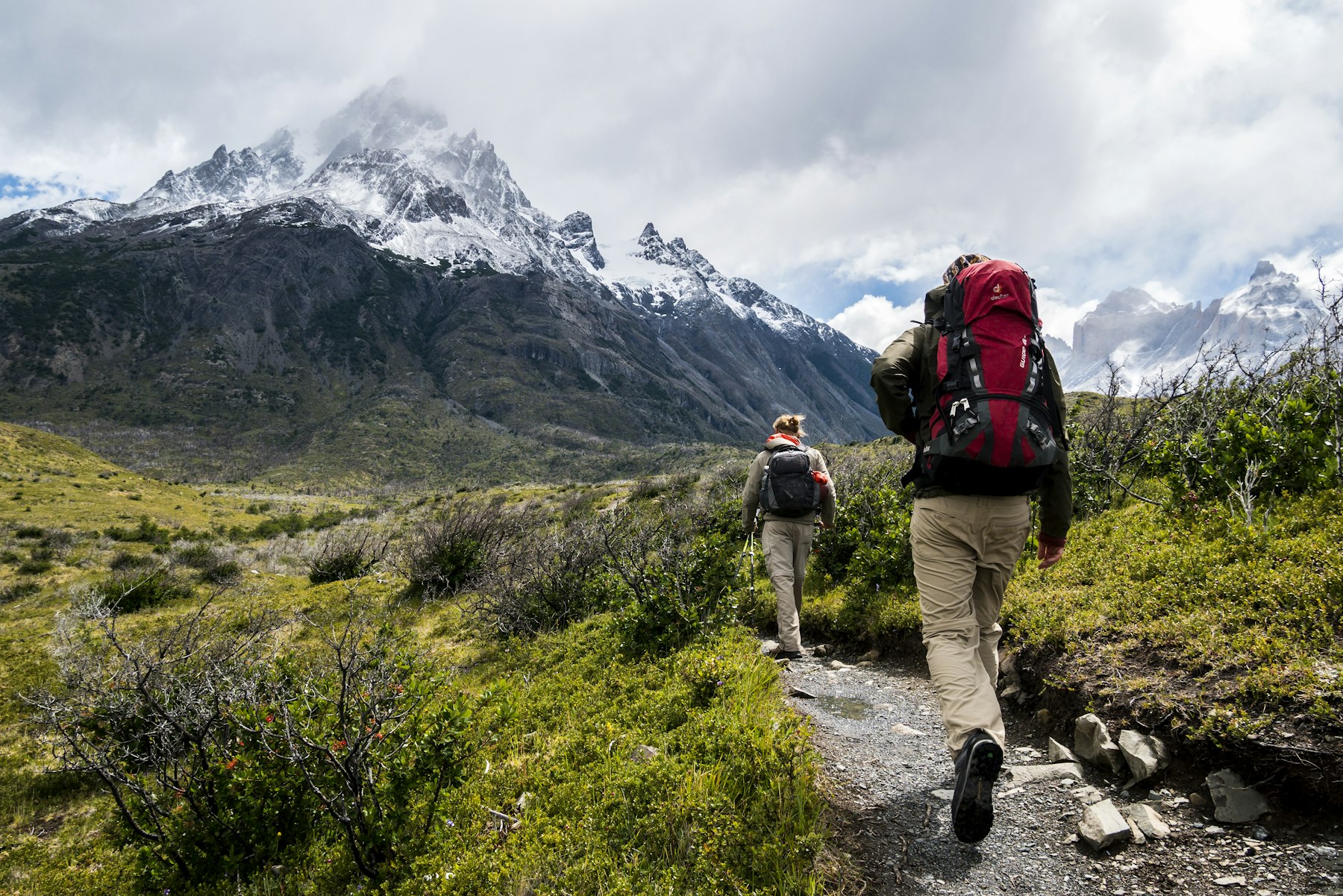
1Ages 2-5 / carrier + short loops2Ages 6-12 / trail-ready
On the Ground Desk|May 2026|L3 field guide
Hike with kids at every age.
Hiking with children is not the same activity as hiking without them. The trail is the same; the planning, the pace, the gear, the bailout threshold, and the definition of success are completely different. This guide is the honest version of that difference.
Primary signalTrail selection by ageField checkCarrier vs. walkingNext layerGear that earns its weight
§ 01
The field test before the trailhead.
01
Trail selection pressure
Elevation gain per mile is a more honest measure than total distance. A 400-foot gain per mile trail will beat a young child faster than a rolling 4-mile loop with 150 feet total gain. Check the elevation profile before choosing, not the star rating.
Check · elevation gainCheck · shade cover
02
Age capacity check
Children's capacity varies more than adults' — a tired 7-year-old and a fresh 7-year-old are different hikers. Build in the assumption that someone will need to be carried for the last mile on any hike over two hours.
Check · bailout optionCheck · carry capacity
03
Gear baseline
Sun protection, hydration, and footwear are non-negotiable. Sneakers on rocky terrain cause ankle injuries. Hiking shoes or boots with real ankle support are the highest-return gear purchase for kids.
Check · footwearCheck · sun protection
04
Snack and water math
Children need more water per pound of body weight than adults, and their blood sugar crashes faster. Carry 50% more food than you think you need and plan snack stops before hunger, not after it arrives.
Check · hydrationCheck · snack timing
05
Turnaround discipline
The turnaround point should be set at the halfway point in time, not distance. Uphill is always faster than downhill with tired legs. Name the turnaround before you leave the trailhead — decisions made tired are almost always wrong.
Check · time midpointCheck · weather window
§ 02
Where the approach changes by age.
Six scenarios by child age
Infant to 18 monthsFull carrier dependency. Front carriers for early months; framed back carriers from sitting-stable onward. Trail choice is adult-limited.
Carrier only. / Any trail / Adult pace
18 months to 3 yearsWalking bursts with frequent carry. Flat, short loops with high landmark density. Keep it under a mile of walking distance.
Hybrid carry. / Flat loops / Under 1 mi
Ages 3 to 5Capable walkers on good days. Expect 1-2 miles max. Elevation gain stops progress faster than distance. Keep the carrier available as a bailout.
1-2 miles. / Low gain / Bailout ready
Ages 6 to 9Real hikers with stamina, but still prone to sudden collapse. 3-6 miles on moderate terrain. Watch for overheating and blood sugar drops in hot conditions.
3-6 miles. / Moderate / Watch temps
Ages 10 to 12Near adult capacity on most terrain. Can handle significant elevation gain and full-day hikes if conditioned. Risk shifts from physical capacity to judgment.
Full day. / All terrain / Judgment watch
TeenagersOften capable of adult or harder routes. The challenge is motivation, not physiology. Involve them in the trail selection and give them real responsibility on trail.
Adult trails. / Challenge needed / Ownership
Deeper routes under this guide
Trails by AgeAge-by-age trail selection: distance ranges, elevation limits, surface types, and what makes a route genuinely manageable versus wishful.
L4-01
Kid Hiking GearThe gear that actually earns its weight: footwear, layers, sun protection, hydration systems, and what to leave at the trailhead.
L4-02
Hiking with ToddlersThe case for short loops, frequent stops, and the mindset shift that makes toddler hiking enjoyable rather than exhausting.
L4-03
Baby Hiking CarriersFront carriers versus framed backpack carriers: weight distribution, age limits, shade solutions, and when to retire the carrier.
L4-04
Trail Snack StrategySnacks as motivation tools, not afterthoughts: timing, calorie density, what works for different ages, and the art of the summit reward.
L4-05
Trail First AidWhat to carry, how to handle blisters, stings, cuts, and sprains on the trail, and when to turn around instead of treating in place.
L4-06
Hiking with TeensThe different challenge of hiking with teenagers: autonomy, challenge level, tech boundaries, and turning a grudging participant into a willing one.
L4-07
National Park Hikes for FamiliesJunior Ranger programs, crowd management, permit realities, and which park hikes actually work with children in tow.
L4-08
Wildlife on the TrailAge-appropriate wildlife awareness, what to do in bear country, snake encounters, and how to turn a sighting into education rather than panic.
L4-09
Planning the First HikeThe logistics checklist for a family's first real trail outing: trailhead parking, weather windows, bailout plans, and setting realistic expectations.
L4-10
§ 03
Age matrix at a glance.
Under 18 monthsCarrier-only. Trail difficulty is adult-set.
Carrier / any trail / adult pace
18 months to 3 yearsShort flat loops, high interest density, expect carry return
Under 1 mi / flat / carry return
Ages 3-51-2 miles, low elevation, keep carrier available
1-2 mi / low gain / bailout
Ages 6-93-6 miles, moderate terrain, watch heat and blood sugar
3-6 mi / moderate / watch temps
Ages 10-12Full-day hikes, most terrain, judgment is the variable now
Full day / all terrain / judgment
TeenagersAdult capacity. Motivation and ownership are the real variables.
Adult trails / challenge / ownership
§ 04
The decision brief in order.
Rule 01
Elevation beats distance.
A trail with 500 feet of gain per mile will exhaust a 6-year-old faster than a flat 4-mile loop. Read the elevation profile, not the distance rating.
Rule 02
The turnaround is a plan, not a decision.
Name the turnaround time before you start. Halfway in time, not distance. Never make a turnaround decision when someone is already tired and emotional.
Rule 03
Feed before hunger hits.
Children's blood sugar drops faster and with less warning than adults. Scheduled snack stops — not reactive ones — are the most effective pacing tool on trail.
Rule 04
Quitting is the correct call.
A successful hike that ends early beats a miserable one that hits the summit. The child who walks off a trail on their own terms will want to go back. The child who had to be carried off crying will not.
Rule 05
Wildlife is information, not emergency.
Teach children before the trail, not during the encounter. The freeze-and-group response should be practiced, not explained for the first time when a bear is in view.
Rule 06
Footwear is the highest-return gear.
Trail shoes or boots with ankle support on rocky terrain are worth more than any other single gear purchase. Sneakers cause ankle injuries. Do not negotiate this one.
§ 05
Reader questions before committing.
Useful edge cases to check.
How far can kids hike by age? A rough rule: one mile per year of age on easy terrain, with a ceiling determined by elevation gain and heat. A 5-year-old may manage 4 miles on a flat shaded loop and struggle at 2 miles on a steep exposed switchback. Always use elevation gain as the primary limiter, not distance.
At what age can kids hike without a carrier? Most children walk reliably on trail by age 3-4, but the carrier should remain available as a bailout through age 5-6. Below that threshold, even willing walkers tire suddenly and need to be carried back. The carrier is insurance, not a crutch.
How do you keep kids motivated on trail? Stop before they ask to stop. Feed before hunger hits. Give them a job: counting wildlife, carrying the trail map, leading the group to the next landmark. Name micro-goals rather than overall distance. And the summit reward — food or a specific activity — should be revealed at the trailhead, not dangled as leverage once motivation drops.
What do you do when a child refuses to walk? Check physical state first: hot spots on feet, dehydration, blood sugar. If it is physical, treat and consider turning around. If it is motivational, try a reframe rather than a push — 'Let's find a good rest rock' beats 'we need to keep going.' If neither works, turn around. A successful early exit is better than a crisis finish.
This L3 page keeps the deeper links in place so the article network can be filled out without flattening the on-the-ground safety architecture.
On the Ground Desk / Safety / L3 Mini-Hub
Hiking with Kids — Trail Selection, Safety, and the Gear That Actually Matters
How to hike with children at every age: choosing the right trails, managing distance and elevation, kid-specific gear, safety protocols, and what to do when someone refuses to walk another step.
Trail selection, age capacity, gear, and safety protocol
1 mile per year of age: the distance baseline
300 feet per mile: elevation limit for under-10s
Carrier availability: critical through age 5-6 as bailout
Turnaround: set at time midpoint, not distance midpoint
The memorable thing: hiking with children is not a scaled-down version of hiking without them. It is a different activity with different success criteria.
A successful family hike is one where everyone walks off the trail on their own terms, wants to go back, and did not get injured. The summit is a bonus. The distance is irrelevant. The elevation profile, the snack timing, the footwear, the turnaround discipline, and the safety protocols are the actual work — and most of them need to be decided before the trailhead, not improvised in the field.
This L3 page is built as a static mini-hub: it gives the reader a complete editorial brief now, then reserves deeper L4 how-to paths for the narrower questions that deserve their own articles. Trails by age, carrier selection, first aid, wildlife protocols, teen hiking, national park logistics — each gets its own article with room to go deep. The parent page here carries the thesis, the age matrix, and the decision order.
Hiking with Kids / Field Note
How to choose a trail that actually works
The common mistake is choosing trails by distance and star rating. Neither tells the right story. Distance tells you how far; elevation tells you how hard. Shade tells you how hot. Landmarks tell you how engaging. Surface type tells you whether boots are necessary or sneakers will survive. A 2-mile trail rated "easy" on a hot, exposed ridgeline will be a miserable experience for a 5-year-old. A 4-mile loop through a shaded forest with a waterfall at mile 2 will be memorable in the best way.
The practical filter for trails under age 10: less than 300 feet of elevation gain per mile, at least partial shade, at least one landmark payoff within the first half of the hike, a clear and well-marked path, and a bailout option if the loop can be shortened. Apply those five filters before applying any distance filter. You will eliminate most bad choices immediately. For children under 5, add a stream crossing or boulder scramble as a positive — young children hike to explore, not to exercise, and terrain variety is motivational in ways that distance is not.
App tools like AllTrails allow filtering by elevation gain, kid-friendliness ratings, and trail surface. Use them. Cross-reference with recent reviews that mention children specifically — a trail that works for a fit adult may have a single technical section that stops a toddler completely. The review ecosystem on AllTrails is genuinely useful here because parents leave specific warnings about things like exposed scrambles, narrow cliff sections, or creek crossings that are impassable after rain.
Hiking with Kids / Field Note
Distance guidelines by age — and why they are ceilings, not targets
The rough rule of one mile per year of age is a ceiling on a good day with good conditions, not a planning target. A 6-year-old can hike 6 miles under ideal circumstances: cool weather, flat terrain, excellent snack timing, high motivation, and a very interesting destination. The same child will bonk at mile 2 on a hot August afternoon with 400 feet of gain per mile. The rule is a useful reality check against overambition; it is not a training program.
For planning purposes, use half the age-rule distance as your comfortable target and the full age-rule distance as your optimistic ceiling. A 7-year-old: plan comfortably for 3-4 miles, accept that 7 miles is possible on the right day. A 4-year-old: plan for 1.5-2 miles and accept that some days you are turning around at 0.8. The goal is not to train the child to hike the planned distance. The goal is to end the day with everyone wanting to do it again. That outcome is more important than the number at the bottom of the Strava file.
Pace management is the most important skill in family hiking and the one most adult hikers get wrong. Adult hiking pace is too fast for children under 8 on most terrain. A child's comfortable trail pace is roughly 1-1.5 mph, not 2-2.5. Planning a "3-mile trail in 90 minutes" will result in a death march. Planning a 3-mile trail in 3 hours with stops, snacks, and exploration time will feel pleasant. Time the trip, not the miles, and build in a 25% buffer for improvisational biology stops.
Hiking with Kids / Field Note
Why elevation gain matters more than distance for children
Elevation gain is harder on small bodies than on adult bodies for two related reasons: the mechanical work of climbing is proportionally greater when leg length is shorter relative to step height, and children have less muscle mass to buffer the lactic acid load of sustained climbing. A 10% grade that an adult barely notices will have a 4-year-old stopping every 50 feet. This is not a willpower issue; it is a physiology issue.
The practical threshold: under 300 feet of elevation gain per mile for children under 10. Under 200 feet per mile for children under 6 in warm conditions. These are not rules that appear in any official guidebook — they are operational guidelines derived from pattern recognition across thousands of family hikes. Some children will exceed them easily; most will find them about right. The useful check is to look at the total elevation profile before choosing a trail and reject any segment where the gain-per-mile exceeds the threshold for the youngest or least-fit member of the group.
Descent is often underestimated as a challenge. Steep downhill is hard on the knees of adults and terrifying to children on loose surfaces. Trails with significant descent on the return leg should be treated as harder than the elevation gain number suggests. Children who had no trouble on the ascent may slow dramatically on steep downhill, particularly late in the day when legs are tired. Factor this into turnaround decisions and carry enough water for the extra time it will take to get out.
Hiking with Kids / Field Note
Carrier versus hiking: the transition years and the bailout principle
The decision to carry or walk a young child is rarely binary. The most functional approach through ages 2-5 is hybrid: the child starts walking, the carrier travels on the parent's back as a bailout, and the carrier gets used for the return leg or whenever the child hits their wall. Committing to a walk-only approach with a child under 4 is optimistic planning that frequently becomes a crisis when the child sits down on the trail at mile 1.5 with no carrier available.
For infants under 6 months, a soft structured carrier (Ergobaby, Lillebaby) worn on the front is the standard choice. The child needs head support, and most framed hiking carriers are not rated for infants without an infant insert. Check manufacturer weight and age minimums before using any carrier for a young infant. From around 6 months, when a child can sit independently and has good head control, the transition to a framed backpack carrier (Osprey Poco, Deuter Kid Comfort, Kelty Journey) makes sense for longer hikes. The framed carrier distributes the child's weight more efficiently across the parent's hips, which matters significantly once the child exceeds 20 pounds.
The carrier retirement age varies by child but most families phase out the hiking carrier between ages 4 and 6 as walking capacity and stamina improve. Keep the carrier available through this transition rather than retiring it prematurely. Children who are pushed to walk beyond their capacity have miserable hikes; children who have the option to ride for 20 minutes and then walk again often have surprisingly long days. The carrier is not weakness — it is a tool that extends the entire family's range.
Hiking with Kids / Field Note
Kid-specific gear: what actually matters and what is marketing
Footwear is the non-negotiable. Trail shoes or boots with actual ankle support on rocky, rooted, or uneven terrain are not optional. Sneakers cause ankle injuries. Children's feet are still developing and have less inherent stability than adult feet; ankle support matters more for them, not less. For flat, smooth, paved nature trails, sneakers are fine. For anything with rocks, roots, incline, or uneven surface, trail footwear is a medical decision. The brands that work well: Merrell Moab Speed Low for kids, Keen Targhee Low, Salomon XA Pro. Fit is more important than brand — a well-fitted trail runner beats a poorly-fitted boot every time.
Sun protection is the second non-negotiable. Children burn faster than adults, are less reliable about reporting discomfort, and have skin more susceptible to UV damage. SPF 50+ sunscreen applied 20 minutes before the trailhead, reapplied at the turnaround point, covering all exposed skin including the back of the neck, ears, and the tops of feet if wearing sandals. A sun hat with neck coverage is not optional on exposed terrain. For toddlers and infants, UPF-rated clothing covers more skin more reliably than sunscreen alone — use both.
Hydration: children need approximately 0.5 liters per hour of hiking in moderate conditions, more in heat. Adults often underestimate children's hydration needs because children do not self-regulate water intake reliably — they need to be offered water on a schedule, not left to ask for it. Hydration bladders (Camelbak Mini Mule) work well for children 4 and up who like drinking from a tube. Water bottles are more reliable for younger children. Electrolyte tablets or powder are worth carrying for hot days or hikes over 2 hours — water alone does not replace the salt lost in sweat.
Layering: mountain weather changes faster than children can regulate. A lightweight down jacket or synthetic puffy packs small and can be the difference between a fun summit and a hypothermic turnaround. Even in summer, above 8,000 feet and in afternoon thunderstorm country (Colorado, most of the Rockies, high Sierra Nevada), a rain layer is not optional. Teach children to put layers on before they feel cold, not after — this takes practice and parental consistency to establish as a habit.
Hiking with Kids / Field Note
Trail snack strategy: motivation, timing, and the summit reward
Snacks on a family hike are not a comfort item. They are a pacing tool. Blood sugar management is the single most effective intervention for preventing the motivational collapse that derails most family hiking days. Children's glycogen stores are smaller than adults', they burn energy faster per unit of body weight, and they give less warning before bonking. The adult experience of "I'm getting a bit hungry" happens in children as "I cannot walk another step and I am furious about everything."
The snack protocol that works: eat something every 45-60 minutes regardless of hunger, not in response to hunger. High-fat, moderate-protein snacks sustain energy more consistently than high-sugar options that spike and crash. Trail mix (nuts, seeds, dried fruit), cheese and crackers, nut butter packets, and jerky all work well. Gummy bears and candy are effective emergency tools for a child who has already bonked — the fast sugar spike pulls them back quickly — but they are not reliable slow fuel. Carry both. The goal is to use the steady fuel and never need the emergency fuel.
The summit reward is a legitimate motivational tool that deserves its own category. A specific snack or activity that only happens at the turnaround point or summit creates a narrative arc for the hike that children can hold in their minds. It works best when revealed at the trailhead ("when we reach the big flat rock, we are having special cookies") rather than introduced as leverage mid-hike ("if you keep walking, you can have cookies"). The distinction matters: the first is an adventure; the second is a transaction that degrades as motivation fails. Make the summit reward a ritual, not a bribe.
Hiking with Kids / Field Note
Trail first aid basics for family hiking
The most common trail emergencies with children are blisters, twisted ankles, cuts from falls, insect stings, and allergic reactions to plant contact. A minimal but functional kid-focused first aid kit: moleskin and blister bandages (applied before the blister forms, as soon as hot spots appear), antiseptic wipes and adhesive bandages, an elastic wrap bandage for sprains, tweezers for splinters and ticks, antihistamine tablets or liquid (check child dosing), and if any family member has a known anaphylaxis risk, an epinephrine auto-injector is non-negotiable.
Blister prevention beats blister treatment. New trail footwear should be broken in on short walks before any long hike. Wool or synthetic hiking socks prevent blisters better than cotton socks, which stay wet and create friction. Check children's feet at the halfway point on any hike over 2 miles — children often do not report hot spots until they have become blisters, because they are distracted and because they have less experience interpreting the sensation. The check takes 2 minutes and prevents a significant portion of hike-ending foot problems.
For minor ankle sprains: stop immediately, apply the elastic wrap firmly but not circulation-restricting, assess weight-bearing ability. A child who can bear weight and walk slowly can usually finish a short trail. A child who cannot bear weight without significant pain should be carried out or evacuated, not pushed. Call for help early if the terrain makes carrying impossible — most national parks and wilderness areas have search and rescue resources available. Do not exhaust the adults attempting to carry a non-weight-bearing child over difficult terrain when professional help is accessible.
Hiking with Kids / Field Note
Wildlife awareness with children: education, not fear
Wildlife encounters on trail are more likely when children are involved because children are less consistent about making noise, more likely to run ahead, and more likely to approach wildlife out of curiosity. The preparation is more important than the reaction — a child who knows what to do before they see a bear will respond correctly; a child who receives instructions for the first time during an encounter will not.
The three-rule framework for children, taught before any hike in wildlife-active areas: stop moving, stay quiet, stay with the adult. These three things apply to almost every wildlife encounter from deer to bears. They are simple enough for a 4-year-old to remember. Practice it at home: "If you see any animal, what do you do?" Drill until it is automatic. Add the specific response for the animals relevant to your destination — in bear country, add "and make yourself look bigger by standing next to me." In rattlesnake country, add "and back up slowly without looking away."
Bear country specifics: make consistent noise while hiking. Talking, singing, and clapping at blind corners prevents the surprise encounters that are most likely to result in a stress response from a bear. Bear bells are less effective than human voice. If a bear is sighted at distance, stop, group together, and observe. Give the bear space to move away and do not approach. Black bears are almost always more afraid of the encounter than humans; the appropriate response in most cases is to give them distance and wait. For grizzly or brown bear territory, carry bear spray and know how to use it before you need to. This is a skill that should be reviewed at the trailhead, not learned during a charge.
Snake awareness is largely a walking habit: watch the trail surface, never step over rocks or logs without looking first, watch where hands go when scrambling. Children are more likely to be bitten than adults because they move fast and without trail awareness. Teaching the habit of looking before stepping is the primary prevention tool. If a snake is sighted on the trail, stop, identify the direction it is facing, and back away slowly. The vast majority of rattlesnake bites occur because someone stepped on or near a snake they did not see — they are defensive, not predatory. A snake on the trail that has room to escape will escape.
Hiking with Kids / Field Note
Turning around without it becoming a failure
The turnaround is the most consequential family hiking decision, and it is almost always made badly. Either the family turns around too late — when at least one person is already miserable and the hike has become a crisis management exercise — or the adults push through when the rational choice was to stop, and the outcome is an injury, a trauma, or a permanently reluctant hiker. The correct approach is to decide the turnaround criteria before you leave the trailhead, not in the field when everyone's judgment is compromised by fatigue and investment.
Turnaround criteria that work: a specific time (we turn around at noon regardless of location), a specific child behavior threshold (the second full stop that is not a scheduled rest), or a weather change (any thunder in the distance). These are objective and non-negotiable. Do not substitute "I think we're about halfway" — that is not a criterion, it is an estimate that gets optimistic when you are invested in reaching the destination.
The framing for turning around matters enormously for whether children experience it as failure or as competent decision-making. "We did it — we made it to the lookout point, and now we're heading back because that's our plan" is categorically different from "we have to go back because you couldn't keep going." The first version teaches children that the plan is to hike and return safely; the second version teaches them that they are the reason the adventure ended. The first version produces hikers; the second produces reluctance. The words cost nothing and the outcome difference is significant. Set the framing at the trailhead: "Today we're hiking to [landmark] and back. That's our hike." Then the return is not a retreat — it is the completion of the hike as planned.
The logistics checklist for a family's first real trail outing: trailhead parking, weather windows, bailout plans, and setting realistic expectations.
The deeper map this page creates.
The L3 page has to do two jobs at once: answer the broad query today and create enough editorial gravity for future L4 articles. The child routes below are reserved article surfaces with a specific reason to exist, a parent topic to inherit, and a narrower reader problem to solve.
That is the difference between a topic cluster and a pile of links. The parent page carries the thesis — hiking with kids is a different activity, not a scaled-down version of adult hiking — the decision order, the age matrix, and the internal linking structure. The child pages can then go deep without re-explaining the entire framework.
L4 expansion / 01
Trails by Age
Age-by-age trail selection: distance ranges, elevation limits, surface types, and what makes a route genuinely manageable versus wishful thinking. This article should not be a thin answer. It should open with the trail-selection pressure, name the traveler who needs it, give specific distance and elevation thresholds by age band, then show how the wrong trail choice produces a crisis. The article should include AllTrails filter guidance, the elevation-gain-per-mile formula, and a readable table of age ranges versus expected capacity.
For this Hiking with Kids cluster, the Trails by Age leaf should inherit the parent logic: a trail that looks short can still be too hard, and the elevation profile is more important than the star rating. The child page should go narrower without becoming smaller. It should include official source links to national park trail ratings where relevant and a practical final action that tells the reader how to evaluate a specific trail before committing.
L4 expansion / 02
Kid Hiking Gear
The gear that actually earns its weight: footwear, layers, sun protection, hydration systems, and what to leave at the trailhead. This article should open with the footwear imperative — ankle injuries from sneakers on rocky terrain are the most preventable family hiking emergency — then move through sun protection, hydration, and layering in order of return-on-investment. Specific brand and model recommendations with age appropriateness are appropriate here; the parent page is too broad for that specificity.
The child page should also address what not to buy: gear marketed to children but designed without trail realism, the cotton sock problem, camelback alternatives for kids who do not like tubes, and the carrier question for families with mixed ages. Practical, specific, and skeptical of marketing is the editorial standard.
L4 expansion / 03
Hiking with Toddlers
The case for short loops, frequent stops, and the mindset shift that makes toddler hiking enjoyable rather than exhausting. The core argument: toddler hiking is an exploration activity, not an exercise activity. Success is measured in engagement, not distance. A trail that provides sensory interest — texture changes, water, animals, interesting rocks — is worth more than an efficient long loop. The article should explain how to read a trail for toddler engagement before arrival, not in the field.
Specific guidance should include: expected walking distances by toddler age, the hybrid carry-and-walk approach with carrier selection, snack timing for the 18-month to 3-year range, how to handle the inevitable meltdown in a way that does not permanently associate hiking with stress, and the right way to frame the trip to a toddler so they understand what to expect. This is a parenting article more than a gear article, and the editorial voice should reflect that.
L4 expansion / 04
Baby Hiking Carriers
Front carriers versus framed backpack carriers: weight distribution, age limits, shade solutions, and when to retire the carrier. This article addresses the specific decision most parents face at 6-12 months: is the soft structured carrier enough, or should we transition to a framed pack? The answer is conditional on child weight, trail terrain, and hike duration, and the article should give a clear decision framework.
Specific models deserve direct coverage here: Osprey Poco Plus, Deuter Kid Comfort, Kelty Journey PerfectFIT versus older Ergobaby and Lillebaby carrier options. Sun shade accessories, rain covers, and the weight-limit issue (most framed carriers max at 48-50 pounds, which many 4-5 year olds exceed). The retirement question: signs the child is ready to fully walk and the carrier can be retired from the hiking kit.
L4 expansion / 05
Trail Snack Strategy
Snacks as motivation tools, not afterthoughts: timing, calorie density, what works for different ages, and the art of the summit reward. This article's core argument is that blood sugar management is the primary performance variable in family hiking, and snack strategy is as important as trail selection for hike success. Specific guidance: snack timing protocol, calorie density comparison by snack type, the difference between slow-burn fuel and emergency fast-sugar tools, and the summit reward framework.
The article should also address the practical side: how to pack snacks for different age groups, whether to let children carry their own snacks (motivational upside, mess downside), allergy considerations on trail, and the calorie math for hikes in heat versus cold. The editorial angle is that this article should make snack planning feel strategic rather than trivial — because it genuinely is.
L4 expansion / 06
Trail First Aid
What to carry, how to handle blisters, stings, cuts, and sprains on the trail, and when to turn around instead of treating in place. This article should be practical and specific. The first aid kit contents for family hiking differ from the solo adult kit: moleskin, child-dosed antihistamine, the epinephrine auto-injector question, tick removal tools, and children's pain relief options. Dosing guidance should reference the pediatrician as the authority, not this article.
The treatment section should cover the four most common incidents: blisters (prevention protocol, treatment protocol, when to stop), ankle sprains (assessment, wrap technique, weight-bearing test, carry-out versus walk-out decision), insect stings (anaphylaxis recognition, antihistamine timing, epinephrine use), and minor cuts on rocky terrain (cleaning, closure, infection watch). The turnaround criteria for each incident type are as important as the treatment guidance.
L4 expansion / 07
Hiking with Teens
The different challenge of hiking with teenagers: autonomy, challenge level, tech boundaries, and turning a grudging participant into a willing one. This article is a different register from the younger-child articles. The physiology problem is largely solved by teenage years; the motivation and autonomy problem is the actual challenge. The article should be honest about the parent-versus-teen dynamic on trail and give practical guidance for navigating it without destroying the relationship or the hike.
Specific angles: involving teens in trail selection (real input, not performative), calibrating challenge level to a teenager's fitness rather than parental nostalgia, phone and technology policies on trail, the value of letting a teen lead, what "challenging" means as a motivational tool versus punishment, and the different risk calculus for teen hikers who may be capable of going faster than the family group. The editorial voice should be realistic, not aspirational.
L4 expansion / 08
National Park Hikes for Families
Junior Ranger programs, crowd management, permit realities, and which park hikes actually work with children in tow. This article covers the logistics specific to national park family hiking that no other article in this cluster does: permit systems and when to apply, the timed-entry reality at peak parks (Zion, Glacier, Yosemite), Junior Ranger program value and logistics, ranger-led hike programs for children, and which specific hikes at major parks are genuinely kid-friendly versus popular-but-difficult.
Crowd management guidance: what time to start to avoid peak trail congestion, the trailhead parking reality, rest stop locations, and the difference between a park's marketing-friendly hike description and what the trail actually requires of an 8-year-old. Official source links to national park Junior Ranger program pages and permit systems are appropriate here as direct links, since those rules change and the article should point readers to the authority rather than reproduce the specifics.
L4 expansion / 09
Wildlife on the Trail
Age-appropriate wildlife awareness, what to do in bear country, snake encounters, and how to turn a sighting into education rather than panic. The core argument: wildlife awareness is a teachable skill that should be developed at home before the hike, not improvised during an encounter. The article should give a simple framework that works for children as young as 3-4, with escalating sophistication for older ages.
Specific coverage: the three-rule framework for any wildlife encounter, bear country preparation and bear spray protocol, black versus grizzly bear response differences, snake awareness as a walking habit rather than a reaction skill, coyote encounters in suburban trailheads (increasingly common), and the educational framing that turns wildlife encounters into positive memories rather than traumatic ones. Official source links to National Park Service wildlife encounter guidance and the North American Bear Center are appropriate here.
L4 expansion / 10
Planning the First Hike
The logistics checklist for a family's first real trail outing: trailhead parking, weather windows, bailout plans, and setting realistic expectations. This article is the practical entry point for families who have never done this before. It should not assume any previous hiking experience and should walk through the full pre-hike checklist from trail selection through post-hike debrief. The tone should be encouraging without being naive — the first hike will be imperfect, and the article should prepare families for that rather than promising a seamless experience.
Specific coverage: how to find a genuinely beginner-appropriate trail (AllTrails filter use, local hiking groups, ranger station recommendations), what to do if the weather changes, the trailhead logistics that first-timers underestimate (parking at popular trailheads, porta-potty availability, trail start times), gear checklist for a first hike, how to debrief with children after the hike in a way that builds enthusiasm rather than cataloguing complaints. The article ends with a clear invitation to the next hike and the internal links to the gear and snack strategy articles that support a second outing.
The decision matrix.
The following gates translate the editorial issue into actions. They are written into the body because search engines need to see the practical depth of the page, and readers need a way to move from reading to doing.
Decision matrix / 01
Check the elevation profile before the trail length.
Check the elevation profile before the trail length is not a decorative checklist item. It is a decision gate. A trail that reads as a short, easy outing may have a single steep section that stops a young child completely. Pull the elevation chart on AllTrails or Gaia GPS before committing, and apply the 300-feet-per-mile limit for children under 10. If any mile of the trail exceeds that threshold, it belongs in a different trip.
The editorial standard is to make the action visible in the moment it matters. Confirm the trail on the planning screen, not the trailhead. A trail that looks fine in the parking lot may look very different after the first climb.
Decision matrix / 02
Set the turnaround time before leaving the trailhead.
Set the turnaround time before leaving the trailhead is a decision gate that prevents the most common family hiking failure mode: continuing past the rational exit because nobody explicitly named one. State it aloud at the trailhead: "We turn around at 11:00 regardless of where we are." Write it on your phone. Hold to it.
The time-based turnaround accounts for the asymmetry between fresh legs going out and tired legs coming back. It also accounts for weather changes, blood sugar management, and the child who is fine until they suddenly are not. The turnaround decision made at the trailhead is always better than the one made 2 miles in with a tired child and a 2-mile walk back.
Decision matrix / 03
Pack 50% more food than you think you need.
Pack 50% more food than you think you need is a practical gate for preventing the blood sugar crisis that ends most failed family hikes. The math: if you plan for a 2-hour hike with two snack stops, pack food for a 3-hour hike with three snack stops. The extra weight is negligible; the insurance value is significant. Children who are adequately fueled stay motivated longer and recover from minor frustrations faster.
The specific foods matter less than the timing. High-fat, moderate-protein snacks sustain energy better than high-sugar alternatives. Carry both slow fuel for the planned snack stops and fast sugar for emergencies. The summit reward goes in a specific, dedicated pocket that the child knows about from the trailhead. That context — knowing where it is and when it appears — creates motivation that survives trail difficulty.
Decision matrix / 04
Check feet at the halfway point on hikes over two miles.
Check feet at the halfway point on hikes over two miles is the single most effective blister-prevention action in family hiking. Children do not reliably report hot spots. By the time a child says their foot hurts, the blister has usually formed. A 2-minute foot check at the turnaround or midpoint — shoes and socks off, look at heels, balls of feet, and little toes — catches hot spots before they become injuries. Apply moleskin immediately when found.
This check also applies to the fit of boot laces, which loosen over the first hour of hiking and allow the foot to shift inside the boot on descent. Retighten laces at the halfway point. Downhill ankle injuries in children are often caused by loose footwear that allows the foot to slide forward into the toe box on steep descents.
Decision matrix / 05
Teach the wildlife rules before you reach the trailhead.
Teach the wildlife rules before you reach the trailhead is a preparation gate that cannot be retrofitted mid-encounter. The three-rule framework — stop moving, stay quiet, stay with the adult — should be practiced as a game at home before any hike in active wildlife areas. For bear country, add the bear spray location and practice the calm-voice noise-making technique. For snake country, walk the "look before you step" habit on the driveway before you apply it on the trail.
The purpose of preparation is to convert a potentially scary encounter into an interesting one. A child who knows what to do feels competent rather than frightened. That competence is a positive feedback loop: children who feel capable on trail want to go back to trail. The wildlife preparation is also an excellent pre-hike engagement tool for children who are not sure they want to go — the chance to see and correctly identify wildlife is genuinely motivating for most young children.
Decision matrix / 06
Frame the turnaround as completing the plan, not failing to reach the goal.
Frame the turnaround as completing the plan, not failing to reach the goal is a language decision that has significant downstream consequences. Families who hike regularly with children know this: the words used at the turnaround determine whether the child's memory of the hike is positive or negative. "We did exactly what we planned" produces a different emotional residue than "we had to give up because you couldn't keep going." The first builds hiking culture. The second does not.
Set this up at the trailhead by stating the plan inclusively — "Today we're hiking to the meadow and back" rather than "Today we're trying to make it to the summit." The objective-based framing allows every early turnaround to be read as goal achievement. The aspirational framing sets up every early turnaround as failure. Over a season of hiking, the language pattern determines whether children develop hiking as an identity or retreat from it as a source of disappointment. This is a small thing that is not a small thing.
Reader action
The practical checklist.
Check elevation profile before trail distance when choosing a route.
Apply the 300-feet-per-mile elevation limit for children under 10.
Set the turnaround time aloud at the trailhead before starting.
Pack 50% more food than the planned hike length requires.
Bring the carrier as a bailout option for children under 5-6.
Apply sunscreen 20 minutes before the trailhead, reapply at turnaround.
Check footwear — trail shoes or boots on rocky terrain, always.
Offer water on a schedule every 30-45 minutes, not when asked.
Check feet at the halfway point on any hike over two miles.
Teach the wildlife rules at home before the hike, not on trail.
Frame the turnaround as completing the plan, not giving up.
Debrief after the hike with what worked, not just what was hard.
Verification
Official and authority checks.
Use these sources for rules and guidelines that affect safety, wildlife protocols, and permit requirements. Editorial judgment helps frame the decision; official sources control the specific rules.
A rough rule: one mile per year of age on easy terrain. A 6-year-old may manage 5 miles on a flat shaded loop and fail at 2 miles on a steep exposed climb. Elevation gain per mile is the real limiter — apply the 300-feet-per-mile threshold for children under 10, and use the age-distance rule as a ceiling, not a target.
What gear is essential for hiking with children?
Trail shoes or boots with ankle support on any rocky or uneven terrain, SPF 50+ sunscreen applied before the trailhead, a sun hat with neck coverage, a hydration system, at least one warm layer even in summer, and a minimal first aid kit with moleskin. For toddlers and infants, a carrier with bailout capacity. These are non-negotiable; everything else is optimization.
At what age can kids hike without a carrier?
Most children walk reliably on trail by age 3-4, but the carrier should remain available as a bailout through age 5-6. Even willing walkers tire suddenly, especially on the return leg. The carrier is insurance against a crisis, not an admission that the child cannot walk. Retire it when the child consistently completes planned distances without needing it.
How do you keep kids motivated on a long hike?
Scheduled snack stops before hunger hits. Micro-goals tied to landmarks, not distance. A summit reward revealed at the trailhead. Giving the child a job on trail — carrying the map, counting bridges, identifying wildlife. Stopping before they ask to stop. The most effective motivation tool is never letting the child reach the point of true fatigue before a rest break.
What do you do if a child refuses to walk?
First check physical state: hot spots, dehydration, blood sugar. If physical, address it and consider turning around. If motivational, try a reframe rather than a push. If neither works, turn around without framing it as failure. A child who walks off the trail on their own terms will want to go back. A child who had to be carried out of a miserable experience will not. Quitting correctly is a skill worth teaching.
How do you handle wildlife encounters with children on the trail?
Preparation is more useful than reaction. Teach the three rules before the hike: stop moving, stay quiet, stay with the adult. In bear country, practice noise-making while hiking. If a bear is sighted, stop, group together, give it space, and do not run. For snakes, freeze and back away slowly. The goal is to convert a potentially scary encounter into a competent, interesting one — preparation makes that possible; improvisation during the encounter does not.
What makes a trail kid-friendly beyond just being short?
Elevation gain per mile matters more than total distance. Shade reduces fatigue and sunburn risk dramatically. Interesting landmarks — waterfalls, boulder fields, stream crossings — provide natural motivation checkpoints. A well-marked path reduces anxiety in children who fixate on getting lost. And a defined destination with a payoff gives the hike a narrative shape that children can hold and anticipate throughout the approach.
The editorial standard for this page.
Hiking with Kids is built to be more than a card in a grid. It is a substantial L3 surface with a visible editorial argument — that hiking with children is a different activity, not a reduced version of adult hiking — a crawlable hidden body with comprehensive coverage across age groups, gear, safety, and motivation, real anchors, official-source links where the topic touches safety rules and park permits, and a clear parent-child relationship inside the On the Ground / Safety architecture.