People assume this is about money, or about being smug at the carousel. It is neither. It is about how many decisions a trip asks you to make, and where in the trip it asks you to make them.
A large bag doesn't ask you anything at home, which is why it feels generous. It asks you every single morning instead — standing in front of it, choosing between things, at exactly the hour you'd rather be outside. A small bag asks everything once, on your bedroom floor, before you go. Then it is silent for the rest of the trip.
That's the trade. Not lighter versus heavier. Deciding once versus deciding daily.
The list, as it stands
This is what actually goes in, not an aspirational version of it. Everything on the left is in the bag. Everything on the right has been in the bag at some point and has been removed, permanently, for the reason given.
In the bag
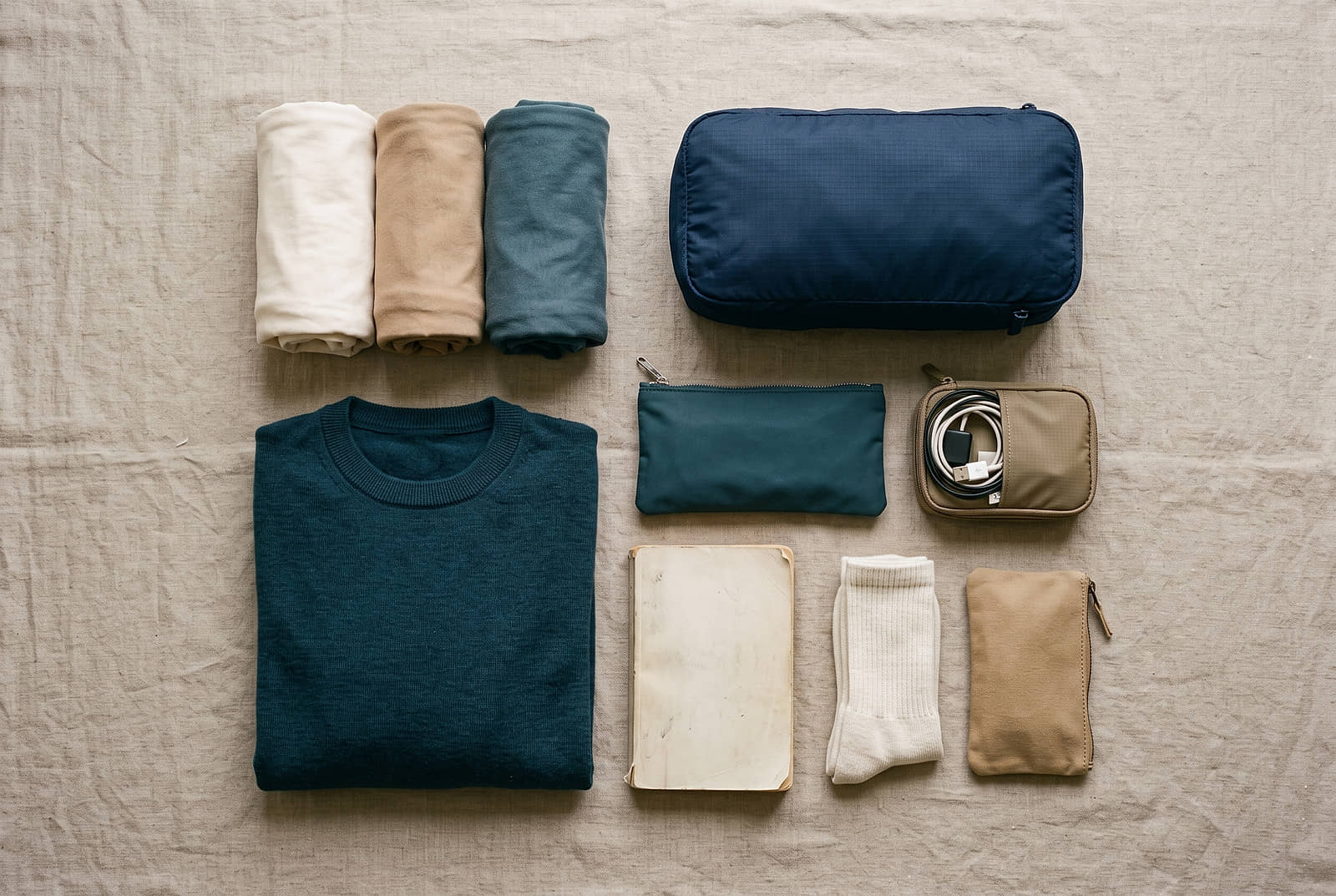
- Three t-shirts, rolled. Same neckline, colours that sit together. Uniform, not wardrobe.
- One merino layer. Does the work of three cotton things and doesn't hold smell.
- One pair of trousers beyond the pair you're wearing. Dark, plain, dinner-capable.
- Underwear and socks for four days. Not for the trip length. For four days.
- One packing cube holding all of the above, compressed.
- A flat toiletry pouch. Solid bar, small toothbrush, whatever you genuinely won't buy there.
- A cable case. Charger, one cable, adapter. One case, closed, findable in the dark.
- The sleep kit. Mask, earplugs, thin layer. Lives here permanently.
- One book with a blank enough cover that nobody starts a conversation about it.
- An empty fabric pouch. For what you buy, and for laundry on the way home.
Not in the bag
- The second pair of shoes. Takes the space of two days of clothes. Wear the ones that do both.
- The just-in-case outfit. The occasion it was packed for has never once happened.
- Full-size anything. Every hotel and every corner shop on earth sells shampoo.
- The spare charger. One charger. If it dies, they sell those there too.
- Travel-specific clothing. The zip-off trousers announce you before you've spoken.
- A towel. Unless you're camping, in which case this isn't your list.
- The gym kit you have never once used on a trip. You know whether this is you.
- Anything bought for the trip the week before. Untested gear fails on day one, always.
Read the right-hand column twice. It's the harder half and it's where the bag is actually won — not by finding cleverer objects but by removing ordinary ones you had no real argument for.
Note what the list doesn't do: it doesn't get longer for a longer trip. The same contents cover a long weekend and cover two months, because the variable isn't clothes, it's how often you do laundry. Every extra day you try to solve with fabric is a day you could have solved with twenty minutes and a sink.
Pack for four days, then decide how often you'll wash. Not the reverse. Everyone who fails at this failed by starting with the trip length and multiplying.
What the constraint actually trades
I'm not going to pretend this is free. It isn't, and the people who sell it as pure upside are the reason it has a slightly evangelical reputation it doesn't deserve.
What you get
- You leave the airport immediately. Straight past the belt, onto the train, into the day.
- Transit stops being fragile. A tight connection, a changed platform, a flight of stairs with no lift — none of it is now a problem.
- Mornings get shorter. There is no choosing. There is one clean shirt and it's the shirt.
- Nothing can be lost by anyone but you. The bag is under the seat, which is the only place it's ever been.
- You can change your mind. Move hotels, add a city, take the night train — all of it is just picking the bag up.
What it costs
- Laundry is now a scheduled event. Not a hardship, but a real thing in the week that you have to plan around.
- You will wear the same clothes in every photograph. Some people mind this considerably more than they expect to.
- Formal is a compromise. The dinner outfit is the plain trousers and the merino, and that's the ceiling.
- Shopping has a cost now. Anything you buy has to fit, which quietly changes what you buy.
- Cold weather takes discipline. The bulk goes on your body, or the whole thing collapses.
If you look at the right-hand column and think none of that bothers me, you were always going to be fine with this and you should just do it. If two of them land, take the small cabin bag instead and pack it like this list — you'll get most of the benefit and none of the martyrdom.
The bag isn't the discipline. The bag is what's left over once you've been disciplined somewhere else. — The actual point
The bag itself
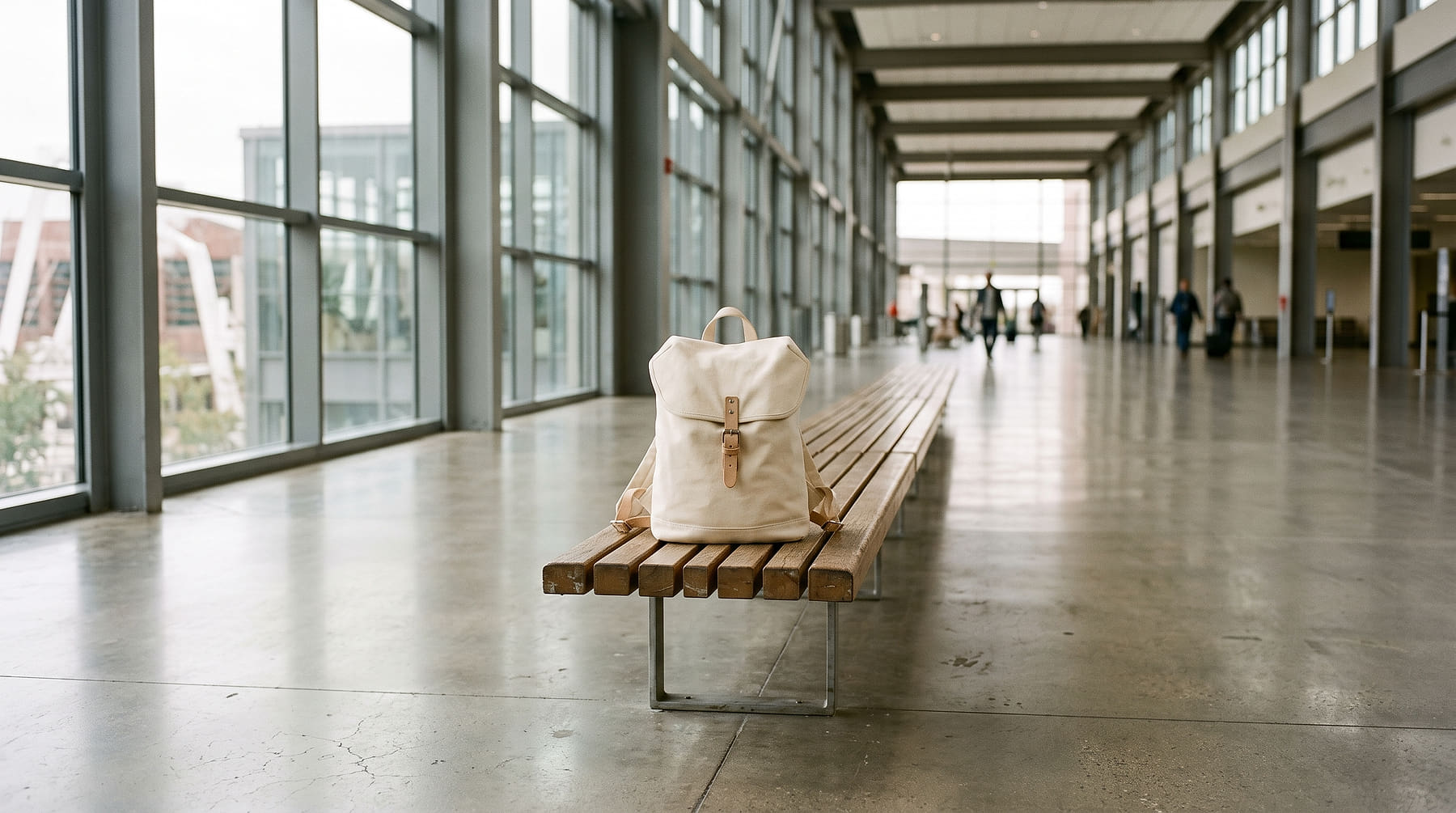
Less important than the list, and worth about four minutes of thought. Soft, structured enough to stand up, opening flat rather than from the top, and genuinely small — smaller than the one that only fits when empty. Expandable panels are capacity you are not permitted to use, so ignore them entirely. The sizer at the gate is the only measurement that has ever counted.
The rest of the kit is unremarkable, and it should be. One compression cube, one flat pouch, one cable case, and the sleep kit that never comes out of the bag — which matters more than it sounds, because the night you need it is the night you have the least capacity to go looking for it.
Amazon is my deliberate default here, and not because it's the best shop — it's because these are commodity objects and I'd rather spend the decision elsewhere. A soft under-seat backpack that opens flat. One compression cube. A flat toiletry pouch that hangs. A small hard cable case, because loose cables in a small bag find the one thing they can tangle with.
Buy them once, test them on a weekend near home, then stop thinking about bags forever.
That is an affiliate link. If you buy through it, HowTo: Travel Edition earns a small commission and your price is unchanged. If you already own a small backpack that opens flat, you own the right bag and you don't need to buy anything.
Nobody has ever regretted this on day nine.
The regret, when it comes, arrives on day one. You will stand in your bedroom looking at a bag that seems obviously insufficient, and you will want to add three things, and every one of those three things will be an argument you're having with a version of the trip that doesn't exist.
By the middle of the week the feeling has completely inverted. You are moving through stations without thinking about it, changing plans without a logistics conversation, and getting dressed in ninety seconds. That's not virtue. It's just what's left when the deciding is already done.
Pack for four days. Wash something on a Wednesday. That is the entire method, and there is nothing underneath it.