The liquids rule is one of the few travel rules that is genuinely simple, and it still gets more bags opened at the belt than anything else I can think of. Not because people don't know it. Because they know a version of it that is slightly wrong in the one way that matters at the one moment it matters.
The wrong version goes: keep your liquids small, put them in a clear bag. That's roughly right and it will still fail you, because it leaves out the two things the person at the scanner is actually looking at — the number printed on the side of the bottle, and whether the object in your hand is a liquid at all. So: the rule as it gets enforced, and then the short list of things that were never liquids in the first place. That second list is the whole game.
The rule, as enforced
One hundred millilitres per container. Three point four ounces if you're flying from the US, which is the same number wearing a different hat. One transparent resealable bag per passenger, about a litre, out of your luggage and into the tray — unless you're at one of the airports where the newer scanners mean it isn't. More on that shortly.
Here is the detail that does the damage: the limit is on the container, not on the contents. A two-hundred-millilitre bottle with forty millilitres left in it is a two-hundred-millilitre bottle. It does not matter that you can see the level through the plastic. It does not matter that you are obviously, demonstrably right. The number is printed on the side, the officer reads the number, and the bottle goes in the bin. I have watched that argument happen in four languages and I have never once seen a passenger win it.
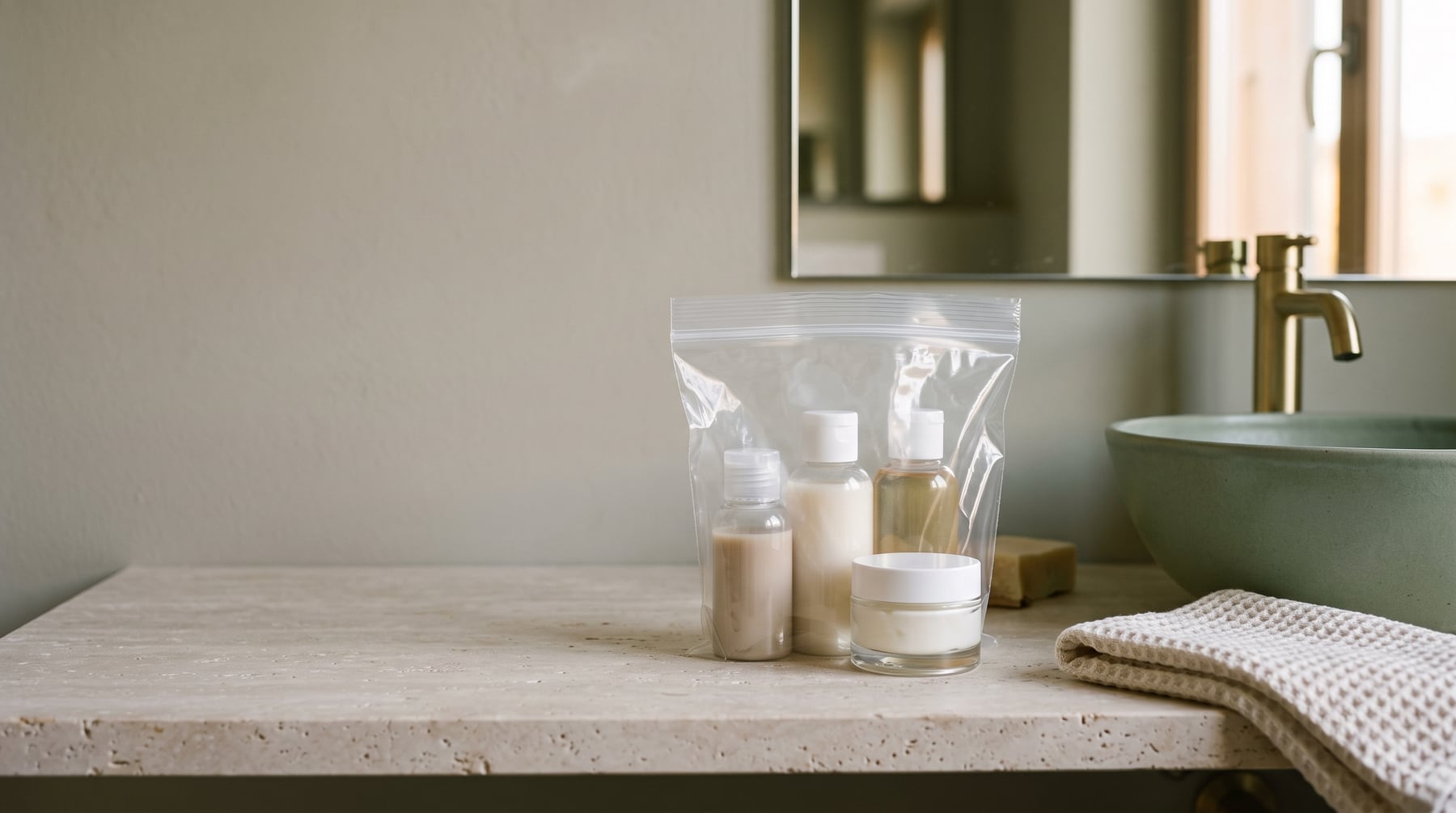
The second detail is that the bag has to close. Not nearly close — close, flat, seal shut, no fingers required. A bag you have to hold pinched between two knuckles is a bag that is too full, and the fix is to take one thing out, which is a much easier decision on your bathroom floor than it is at the front of a queue.
Every container reads 100 ml or less on its side, and the bag zips shut without being held. If both of those are true, you will not be stopped.
What counts, and what doesn't
The category is wider than the word suggests. Liquids here means anything that pours, spreads, smears or sprays, and all the arguments happen at the edges — where a thing is technically a paste and psychologically a snack.
Counts as a liquid
- Anything that pours. Water, contact lens solution, the small bottle of oil you were going to bring back.
- Gels and pastes. Toothpaste, hair product, sunscreen, hand sanitiser.
- Creams and thick balms. Moisturiser, foundation, anything in a pot you'd apply with a finger.
- Aerosols and sprays. Deodorant, dry shampoo in a can, perfume with an atomiser.
- Mascara and liquid liner. Small, forgotten, and the single most common thing pulled back out of a bag.
- Soft foods. Yoghurt, honey, jam, peanut butter. Famously, repeatedly, peanut butter.
Isn't a liquid at all
- Bar soap and shampoo bars. Solid the whole way through. Doesn't go in the bag.
- Toothpaste tablets. Chew, brush, done — and it removes the largest tube you were carrying.
- Solid stick deodorant. The roll-on is a liquid. The twist-up stick isn't. Same shelf, different rule.
- Solid perfume and balm in a tin. Same scent, no atomiser, no conversation.
- Powders. Powder shampoo, powder foundation — though a very large quantity does attract a second look.
- Wipes. Damp, but not a liquid. They travel loose in the bag.
Read the right-hand column twice, because that's where this actually gets solved. The instinct is to go and buy smaller bottles. The better move is to take three things out of the category altogether, at which point the litre bag stops being a packing problem and becomes something you barely think about.
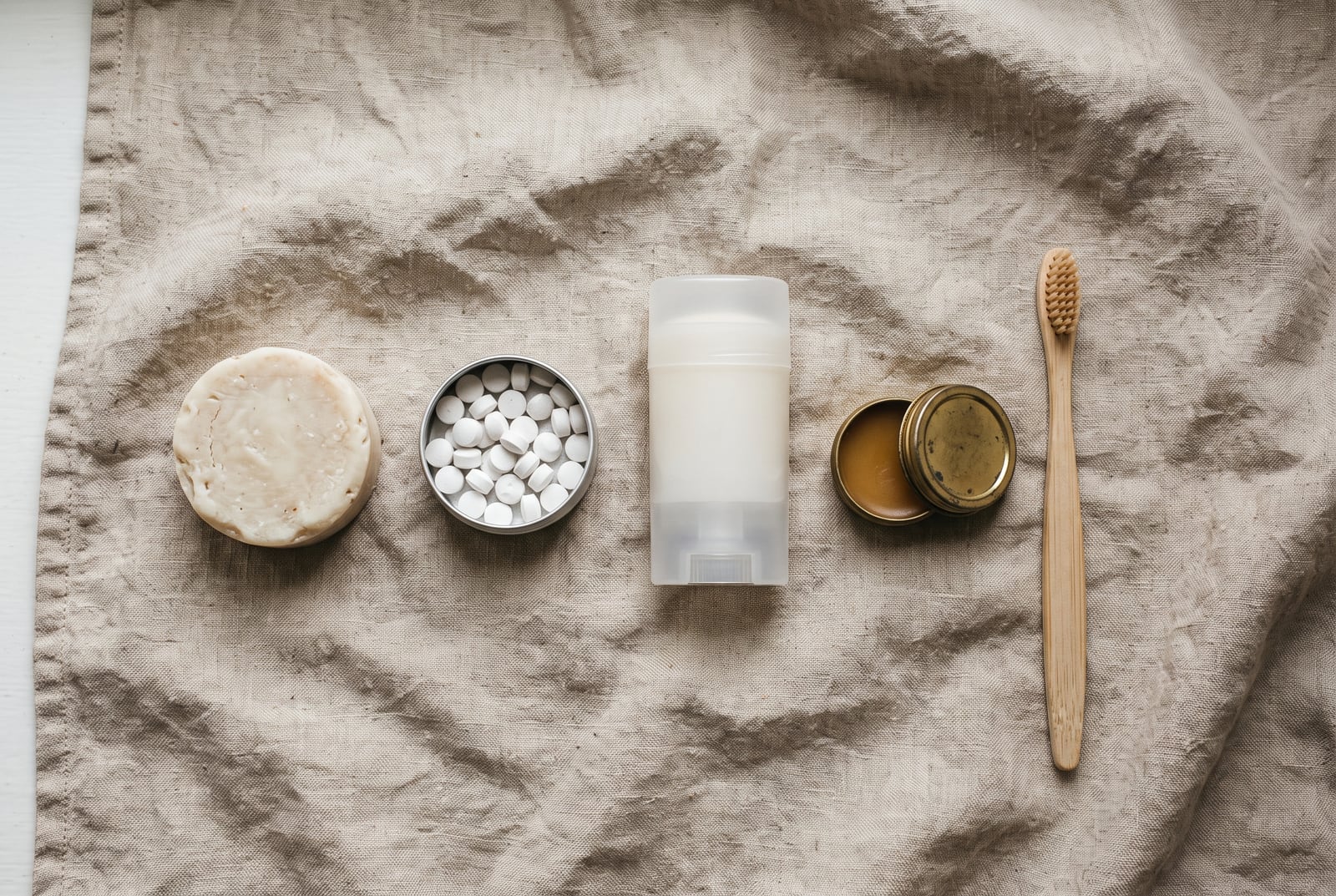
There's a real trade here and I'd rather say it. Shampoo bars take about a week to get used to, they need to dry properly before they go back in the tin, and a few of them are genuinely unpleasant. Toothpaste tablets taste like chalk for the first three mornings. Switch all of it at once, the week before a trip, and you will dislike all of it at once and go straight back to bottles. Change one thing, live with it at home for a month, then change the next one.
Where it goes wrong after security
Duty free is the first way. You buy a bottle past the checkpoint, it comes in a sealed tamper-evident bag with the receipt showing through the window, and that is entirely fine — right up until you connect through an airport where you clear security again. Then it's just a large bottle of liquid in your hand luggage and it's gone. Connecting through the US is the classic version, because you re-screen after immigration, but it is not only the US.
Medication is the second, and it's the opposite problem: it's exempt almost everywhere and still worth handling deliberately. Prescription liquids, contact lens solution and anything for a baby generally come out of the litre bag and get declared separately rather than squeezed in. Carry what you need, keep it findable, and say the word before somebody else finds it.
Everything beyond that is local variation. Some airports have the newer CT scanners and will send the bag through inside your luggage; some have them and still ask; some have narrowed the allowance back again after opening it up. It's the departing airport's rule that governs, not the arriving one — and the airport you fly home from is a different airport with a different answer.
The number is printed on the side of the bottle. The officer reads the number. You do not win this one by being right. — The container rule
What's in mine
Less interesting than the list, and worth about four minutes of thought. Bottles stamped 100 ml rather than approximately that size, because the unmarked ones invite exactly the conversation you're avoiding. Squeezable rather than rigid, because the rigid ones split at the seam and you find out inside a bag of clean clothes.
Amazon is where I buy this, not because it's the best shop but because these are commodity objects and I'd rather spend the decision somewhere else. A set of small bottles with the capacity moulded into the plastic, a couple of squat jars for anything thick, and a clear zip case that lies flat in the wash bag. Silicone over hard plastic, every time.
Buy it once, fill it once, and leave it filled between trips.
That is an affiliate link. If you buy through it, HowTo: Travel Edition earns a small commission and your price is unchanged. If you already own a set of small bottles that close properly, you have already solved this and you don't need to buy anything.
The rest of the wash bag is solids, bought wherever you already buy soap. They travel with everything else, they never see the tray, and they're the reason the litre bag has room in it at all — the same principle as the rest of the personal item, where the objects you removed do more work than the ones you chose.
This isn't about the bag. It's about never thinking about it again.
Every version of this problem that survives is a version where the decision is still live. There's a drawer of half-used bottles, it gets repacked every trip, and every trip there's a small moment at the tray where you aren't quite certain. That uncertainty costs more than the bottles do.
Set it once instead. Containers stamped with the right number, a case that closes, three things moved permanently out of the category, and the whole kit lives in the wash bag rather than being built the night before you fly.
Then the belt is just the belt, and you walk past it thinking about something else.